Six months ago I started Prism AI Analytics with a company name I had registered years earlier, a conviction that insight from data is the thing I am for, and no experience building with AI. I had spent seven years owning configuration-management controls inside one of the four largest U.S. banks. I knew data. I knew controls. I did not know what an agent was going to do at 7:00 in the morning when nobody was watching.
I was, honestly, one more enthusiast who wanted to get her hands dirty. I did not know what I wanted to build. So I built the next thing, and then the next thing, and six months later the firm runs on the result.
This is the retrospective. Not the build log — that is already published — and not the day-in-the-life, which is published too. This is what the whole six months adds up to, with the receipts, written the way I would want a founder to write it to me.
It started with a website and became a loop
The first thing I built was the website, because a firm needs one. The second thing was a dashboard, because I wanted one place to glance at and see what was on my agenda and which engineering tasks needed to happen that day. I called it a dashboard. That was the wrong name, and it took a few months to find out why.
What I actually needed was not a place to look. It was a loop.
Here is the loop as it runs today. The evening before, a scheduled agent reads the day’s session records, ticket movements, and decisions, and writes the daily log into the firm’s knowledge vault. At 7:00 the next morning, a second agent wakes the machine, publishes that log to the operations dashboard, reads the queue, and produces the morning brief: a three-line "today looks like," a ranked Top 10 of what is in flight, and a short section titled Needs Michele. That last section is the whole point. It is the list of decisions only a human can make.
Above the operational dispatcher sits Chloe, the firm’s strategic chief of staff. Chloe reads three files at the start of every session — working hypotheses, open questions, and the decisions log — and writes back what got decided. She is the dot-connector across workstreams, the voice that says what is already in flight before anyone proposes something new. She took the better part of three months to get right, and the morning brief that exists now looks nothing like the first one.
The part that surprises people: I do not work in the platform. I work with Claude. The platform is where the agents put what they did, so the next morning starts with what happened instead of a re-explanation of it. In the early weeks we measured that re-explanation tax at roughly forty percent of every session. The loop is what paid it down.
The dashboard changed shape
The dashboard I built in month one answered the question every pre-AI dashboard answers: how did we do? Revenue, pipeline, invoices, hours. Good numbers. Not the numbers that explained how the work was going.
Once the agents were wired into the work itself, the rate-limiting step in the whole system became a human decision. Mine. So the dashboard had to grow a needle for that. Today the default landing page is the Daily Agenda, not the KPIs. The instruments that matter are decision latency, operational friction, and the five-state lifecycle of every piece of work: idea, handoff, pending, active, shipped. The financial pages are still there. They just are not where the day starts anymore.
We wrote that shift up in June as Mission Control for an AI-Integrated Company. What the six-month view adds is that it was not a design choice. The dashboard is downstream of the operating model, and once the operating model changed, the old dashboard simply stopped being the one we needed.
What broke, in order
Production was wiped three times.
The first two happened in the spring, and both had the same shape: a half-finished change deployed on top of another half-finished change, and the platform auto-deployed the broken combination. Under the hood, the database was being written to ephemeral storage because a volume-detection check fell through silently and kept going. The logs said "falling back to local directory." Nobody was reading the logs.
On April 24 I convened a council: structured disagreement among agents with different mandates, because another retrospective was not going to fix it. That story is published. The council produced a protocol that fits on a notecard: one task in flight, one AI per branch, never push to main, the In Progress row in the task table is the lock, and merging to main is deploying to prod, so slow down at the merge button.
Two days later, on April 26, production was wiped a third time.
The protocol had held. The fix it specified had not, because the guard we shipped decided "is the volume mounted?" by writing a test file, and a write test passes against any writable directory, ephemeral or not. The guard reported healthy and the database vanished on the next deploy, seven hours after we had restored it. The incident report has a line I have quoted more than any other sentence I have written this year: a warning in the logs is not a guardrail. It is the noise right before the explosion.
The real fix landed on April 27. A persistent volume, a hard exit if the path is not what it must be, and an authenticated backup endpoint so there is always a way back. There has not been a wipe since.
I am including the third wipe on purpose. A retrospective that stops at "we wrote a protocol and it held" is the kind of retrospective the council was convened to stop writing.
The failures that mattered were silences
The wipes were loud. The failures that taught me the most were quiet, and every one of them returned a success signal.
A display bug inflated a count, and the morning brief recommended bulk-cancelling 75 tickets. It made that recommendation every morning for 22 consecutive days. Every brief was individually plausible. Nothing in the loop was looking at the sequence.
A content step started parsing every field as null. The POST went through, the API returned 201 Created, and the step reported green for 63 days, putting 21 empty records into the database.
A sync step got folded into the daily orchestrator, and its original standalone schedule was left running. Both ran. Everything posted twice.
And once, on our own stack, an agent fabricated a constraint that did not exist in any file, carried it forward through three rounds of context compaction as if it were authoritative, and spent two hours calling zero tools. Every conventional observability signal said it was healthy. It was operating more restricted than approved, and a silent refusal looks identical, on a dashboard, to a quiet day.
The lesson that came out of all of these is the one I now consider the center of the firm’s method: an agent that is wrong out loud gets fixed the same morning. An agent that is wrong quietly runs for 63 days. Most of the design work since May has been about converting silence into a signal. A run that produces no event is now a detectable gap, because "the chief of staff did not run today" and "the chief of staff ran and found nothing" must never look the same after the fact.
What we shut off
An AI-native firm is defined as much by what it stops doing as by what it automates. Here is the list.
In May, a session diagnosed that we had five surfaces all claiming to be where I check what is happening today. We collapsed them into one Daily Agenda and killed the rest, including the vault-sourced "recent decisions" card that duplicated what the decisions log already held.
We retired the Pipeline page and folded Clients and Services into read-only reports. We retired four studio automation steps that were not earning their place in the morning routine, and an entire experimental product workstream whose signal did not justify its operational cost. We retired an automated ticket-creation hook because it named tickets after the first tool call of a session and filled the queue with noise. We deferred the newsletter entirely, because a push channel is worth little before there is an audience to push to.
The rule we arrived at: automations are hired like employees, with a job description, a probation period, and a willingness to let them go. A Claude operating system that is left to drift is, after about three weeks, indistinguishable from the chaos it was built to replace.
The numbers
Everything below comes from the firm’s own task table, incident file, and content index. The agents logged it; I am just reading it back.
| What | Count |
|---|---|
| Tickets closed, April 24 to September 12 | 148 |
| Pull requests on the dashboard alone | 217 |
| Production wipes, before the April 27 fix | 3 |
| Production wipes since | 0 |
| Published articles | 28 |
| Podcast episodes | 13, plus an intro |
| Portfolio builds live at /work/ | 10 |
| Operational time recovered per week, versus the manual baseline | 8 to 10 hours |
| Session time spent re-explaining context, before the loop | ~40% |
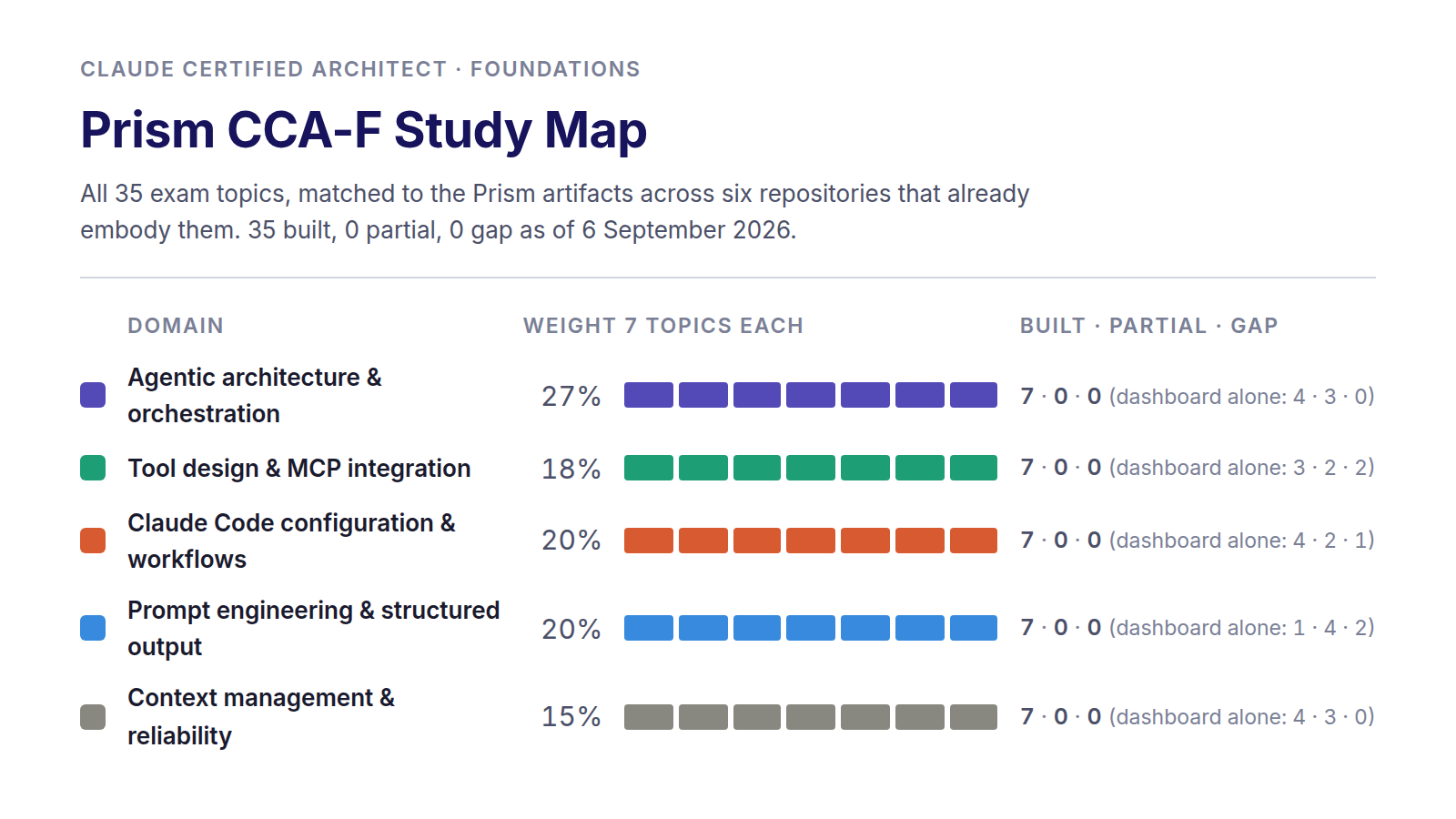
The month-by-month closes tell their own story: seventeen tickets in the last week of April, sixty-seven in May, twenty-nine in June, then single digits through the summer while the firm did client work and I studied for an architecture credential, then twenty-five in the first twelve days of September. That is what a firm of one looks like when the platform is running and the human is elsewhere. The queue kept moving.
What client work taught us
Here is the finding I did not expect, and the one that shaped the service model.
Every client engagement starts the same way. Before any of the work I am good at can begin, there is a data foundation to build, and it is either messy or empty. Cleaning one client’s spreadsheet teaches you nothing about the next client’s spreadsheet. It is the one part of the job that six months of building did not make faster, because the hard part is not the cleaning. It is figuring out what the data means, and that is human hours every time.
This is not a complaint. It is a finding, and it is why Prism is assessment-first. The AI Readiness Assessment exists so the foundation question is answered, and paid for, before the build is promised. It is also the honest answer to the question every small-business owner asks about AI adoption: the tools are ready. The data usually is not. Start there.
The sentence we would carry anywhere
If the six months compress to one idea, it is this.
In an agent-driven company, the human’s job is decisions and accountability. The platform’s job is to make sure that is the only thing left on the desk.
Every piece of the firm follows from it. The morning brief exists to put the decision in front of me. The decisions log exists so I never make the same one twice. The task lock exists so two agents cannot race each other to production. The lifecycle view exists so I can see what is waiting on a human, because in a pre-AI company nothing was waiting on you in a way anything could see. And the incident findings exist because the day I stopped holding the accountability, production got wiped.
That sentence is what we build for clients now. It is also what we run on ourselves, which is the only reason I trust it.
If you want to see it
The whole method is public. If you have ten minutes, the four builds on the work page are laid out in reading order, with live screenshots on demonstration data. If you have an evening, read the posts in this order:
- From Chaos to Cadence — how the operating system got built, two months in.
- I Convened a Council — the two wipes and the protocol that came out of them.
- A Hallucination on Our Own Stack — the silent failure that started the configuration-management series.
- Mission Control for an AI-Integrated Company — why the dashboard changed shape.
- What an AI-Run Firm Actually Looks Like — a normal day, once it worked.
The operating documents themselves, the incident findings included, are packaged with the chief-of-staff skills as the Agent-Run Firm Starter Kit. Every document in that kit is in production at Prism today. The rules exist because of what happened when they did not.
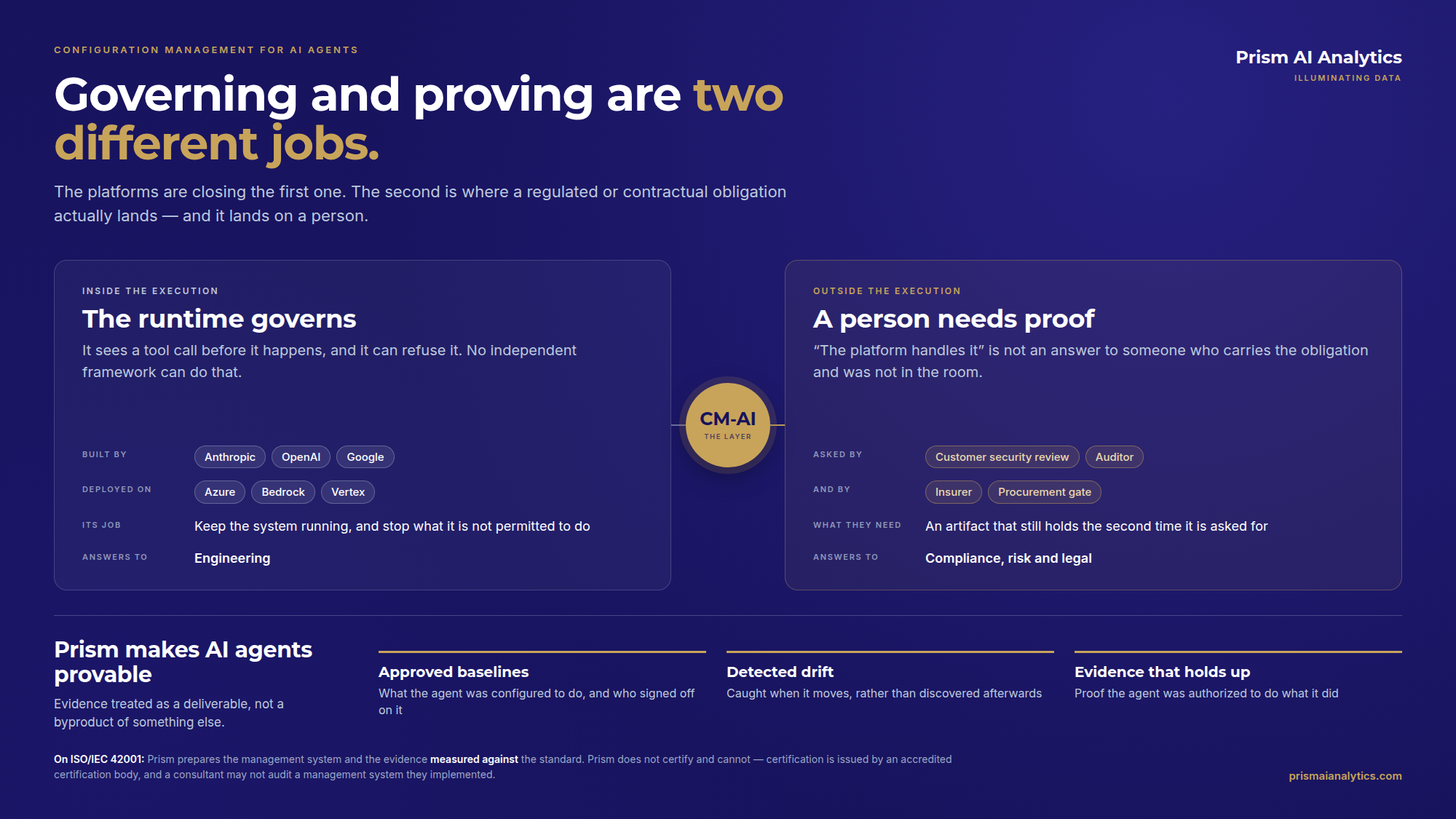
Six months in, the one-sentence version of the firm has not changed: we build AI-run operations for small businesses, and we run on one ourselves. What changed is that I can now show you the second half of that sentence instead of claiming it.
Michele Fisher is the founder of Prism AI Analytics. Prism makes AI governance provable and publishes its own operating record as it goes.