Five weeks ago we published the operating-system post — the record of how Prism wired Claude into a multi-workstream consulting firm. That post described the build. This one describes the result: a normal day inside a firm where the operations genuinely run on agents, written for the owner who wants to know what "AI-run" means before anyone asks them to buy it.
The one-sentence version of Prism now: we build AI-run operations for small businesses — and we run on one ourselves. Everything below is the second half of that sentence, shown rather than claimed.
6:15 the evening before
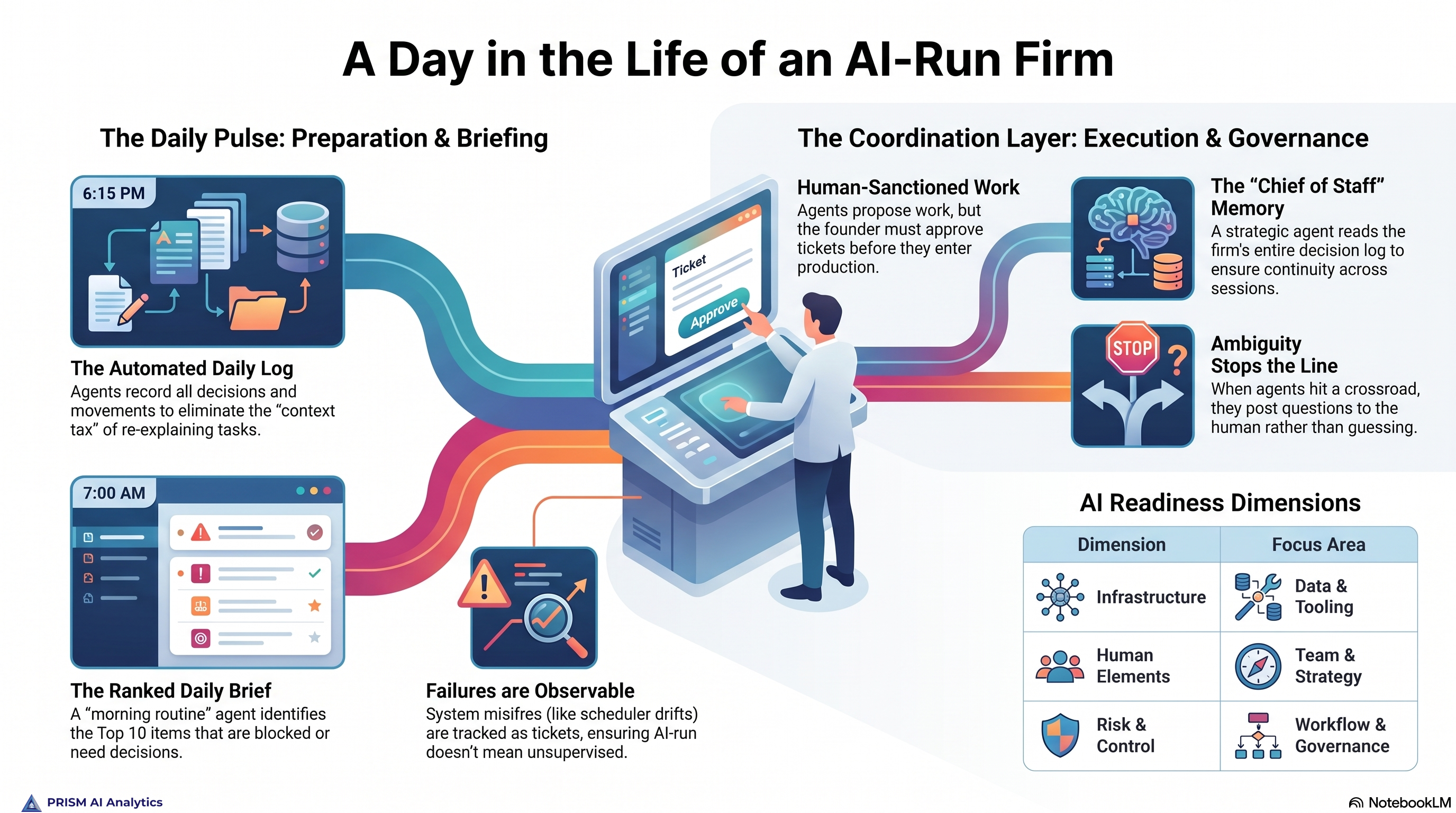
The day starts the night before, without anyone at the keyboard. A scheduled agent reads the day’s session records, ticket movements, and decisions, and authors the daily log — what shipped, what stalled, what got decided and by whom. It files the log in the firm’s knowledge vault, where every other agent can read it.
This is the unglamorous foundation of everything else. An agent that knows what happened yesterday does not spend the first twenty minutes of a session being reminded. The context tax we measured in the early weeks — roughly forty percent of every session spent re-explaining — is paid down here, once, automatically.
7:00 the next morning
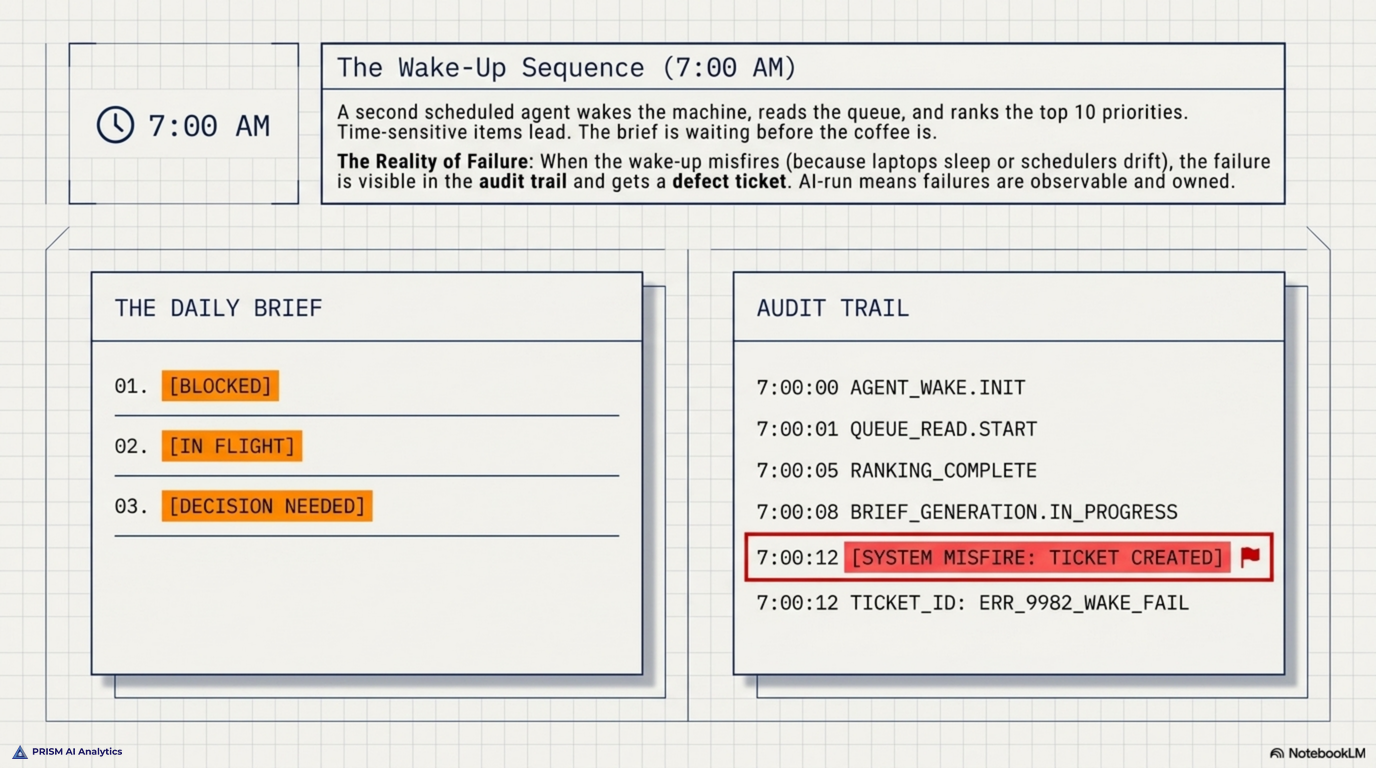
A second scheduled agent wakes the machine and runs the morning routine: it publishes yesterday’s log to the operations dashboard, reads the ticket queue, and produces the daily brief — a ranked Top 10 of what is in flight, what is blocked, and what needs a decision. Time-sensitive items lead. The brief is waiting before the coffee is.
Neither of these runs requires a human. Both leave an audit trail. When the wake-up misfires — and it has, because laptops sleep and schedulers drift — the failure is visible in the logs and gets a ticket like any other defect. AI-run does not mean flawless. It means the failures are observable and owned.
The queue is the firm
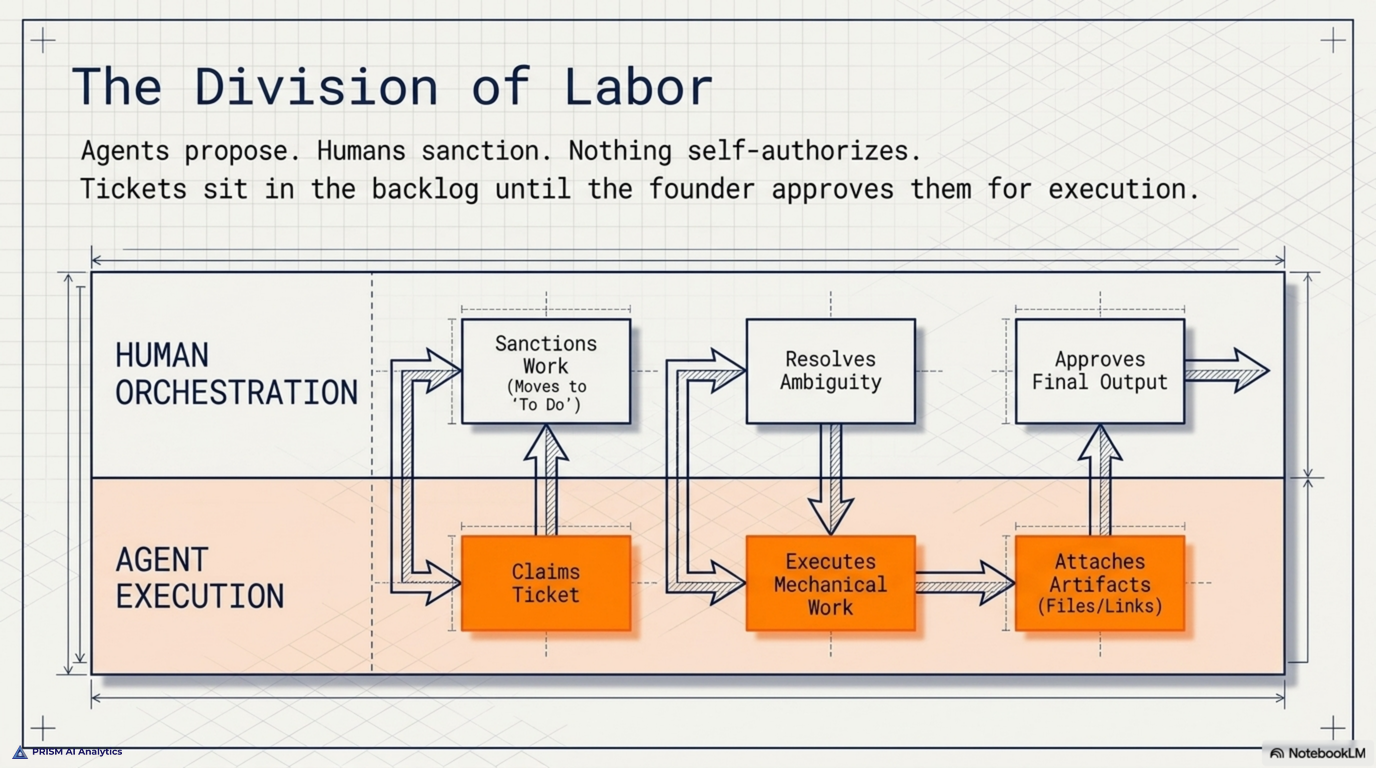
Every piece of substantive work at Prism lives in a ticket. Not as bureaucracy — as the coordination layer between one human and many agents. The queue has a discipline the whole firm runs on:
- A human sanctions the work. Agents propose; tickets sit in Backlog until the founder approves them into To Do. Nothing self-authorizes.
- Agents claim and execute. A session picks up a ticket, works it, and attaches its artifacts — files, links, verification — as it goes.
- Ambiguity stops the line. When an agent hits a decision it should not make alone, it does not guess. It posts the specific question to the ticket, the ticket flips to Review, and a tile on the dashboard increments. The founder answers; work resumes. The worst automation failure mode — a confident agent proceeding on a wrong assumption — is engineered out at the process level.
- Closing leaves evidence. A finished ticket carries a closing record: what shipped, what was verified, what follows. An auditor, a future hire, or next month’s session can replay any decision from the trail.
The result is a firm where the founder’s job is orchestration — deciding what gets built and judging what came back — while the queue absorbs the coordination overhead that normally eats a solo operator alive.
The chief of staff who never forgets
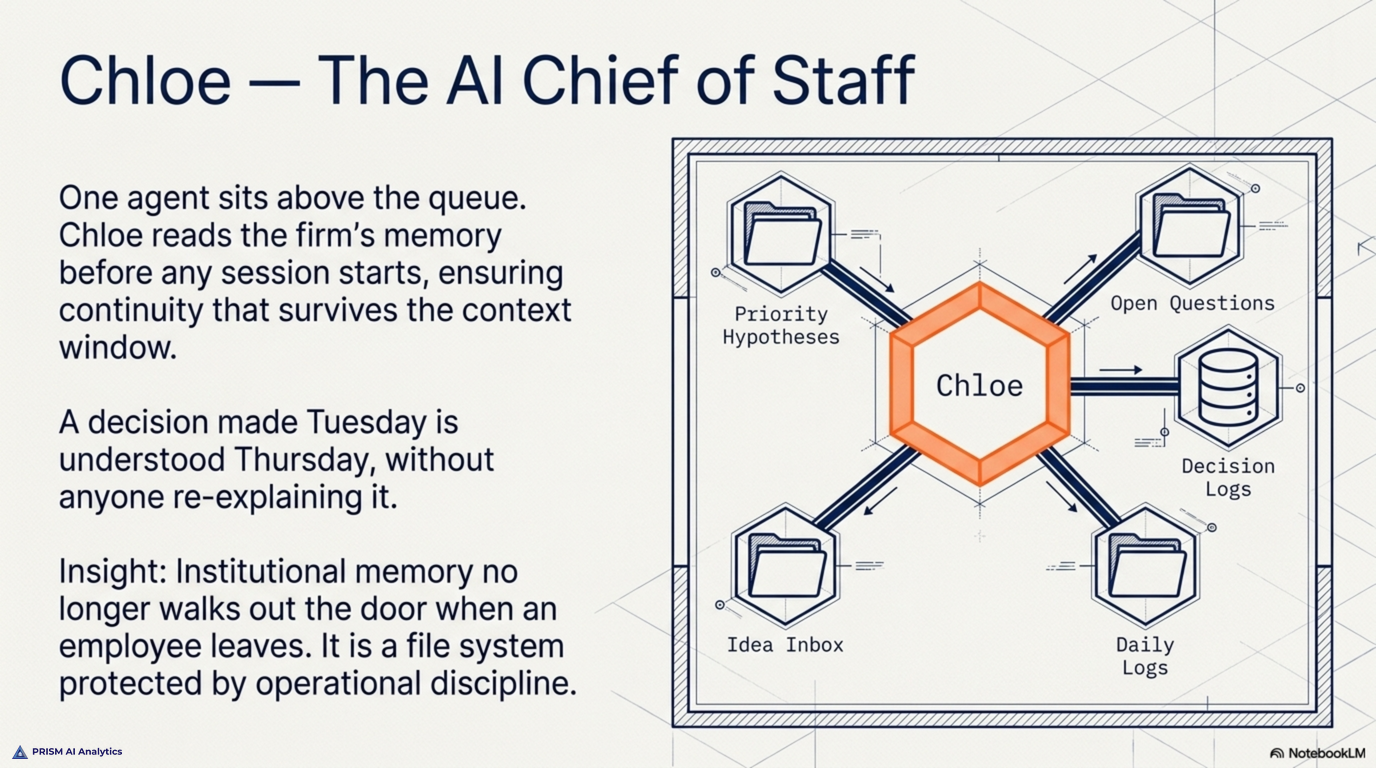
One agent sits above the queue. Chloe, Prism’s strategic chief of staff, opens every working session by reading the firm’s memory: current hypotheses about priorities, open questions waiting on decisions, the decision log, the recent daily logs. She surfaces what is in flight before anything new gets proposed, captures stray ideas to an inbox instead of letting them derail the work, and writes the session’s decisions back to the log on the way out.
The practical effect is continuity that survives the context window. A decision made in a Tuesday session is known — with its reasoning — in the Thursday session, without anyone re-explaining it. Ask any small-business owner what institutional memory is worth when it walks out the door with an employee. Ours is a file system with a discipline around it.
Delivery runs on the same rails
Client work follows the same pattern as internal work. Prism’s AI Readiness Assessment — the diagnostic we lead with — is delivered by an engine of six coordinated agent skills that score a business across six dimensions and produce a findings report with a 90-day roadmap. The founder runs the debrief and owns the judgment; the engine does the assembly. The same queue discipline applies: the engagement is a ticket, the artifacts attach to it, the close-out is auditable.
Content runs the same way. Every post you read here moves through a pipeline — drafting, a brand-voice scan that catches banned consultancy phrases and voice drift, image processing, and a publishing bundle — with an agent doing the mechanical legs and a human approving the gates.
The part where we tell you what it is not
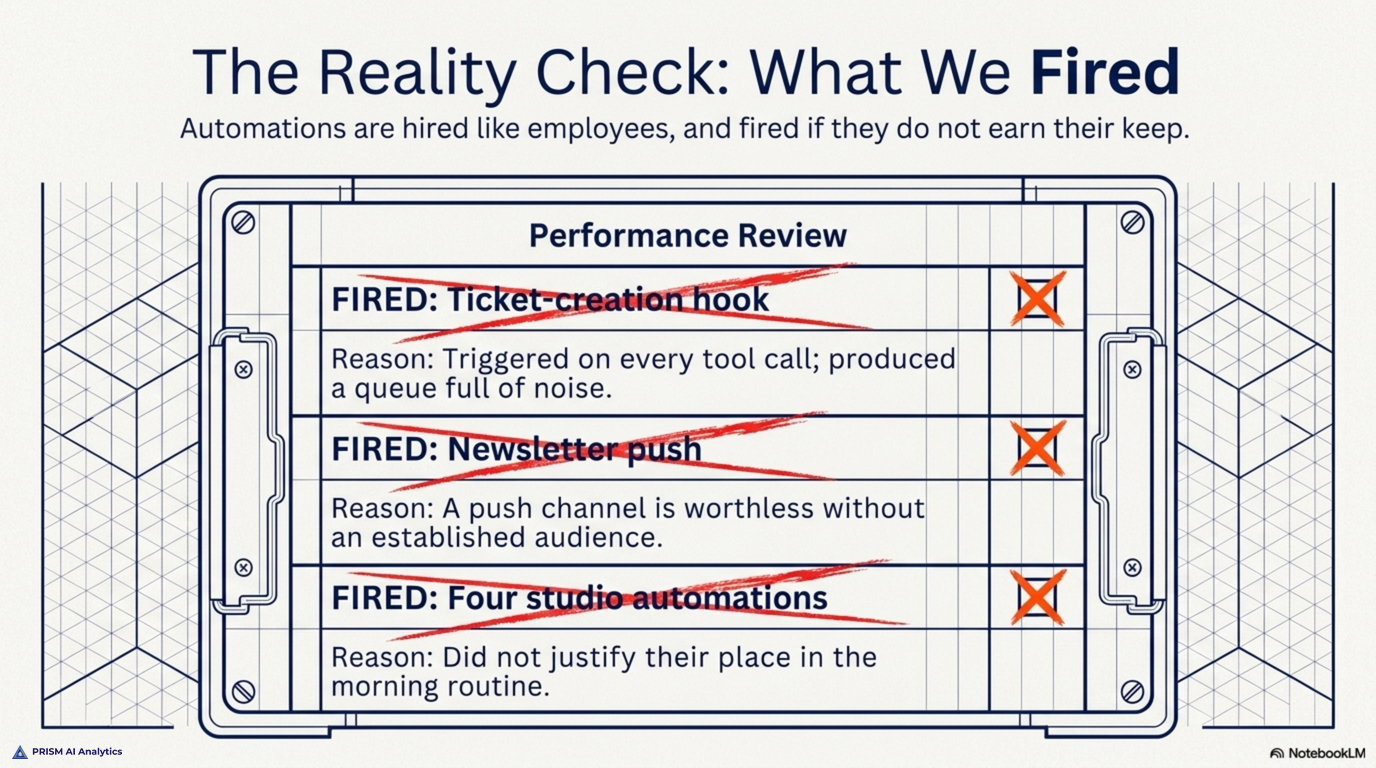
An honest operations log includes the things we turned off.
We retired an automated ticket-creation hook because it named tickets after the first tool call of a session, which produced a queue full of noise. We shut down four studio automation steps that were not earning their place in the morning routine. We deferred the newsletter entirely — a push channel is worth little before there is an audience to push to. One automation double-posted a daily log until we traced it to two schedulers owning the same job, and the fix was a rule about which scheduler is allowed to exist, written down where every future session reads it.
This is the actual texture of an AI-run firm: not a demo, an operations discipline. Automations are hired like employees — with a job description, a probation period, and a willingness to let them go. The ones that stay are the ones that survive contact with real work. Adoption is challenging enough without pretending otherwise.
The trust layer
Every agent in this system carries three things: a baseline that records what it is approved to be, a rollback plan for when a change goes wrong, and an audit trail of what it actually did. We learned that discipline doing configuration management at one of the four largest U.S. banks, published our methodology openly, and practice it on our own systems daily — the way a good contractor builds to code without selling code compliance as a line item.
You will notice this is one paragraph, not the headline. That is deliberate. Governance is how we build, not what you buy.
What this means if you run a small business
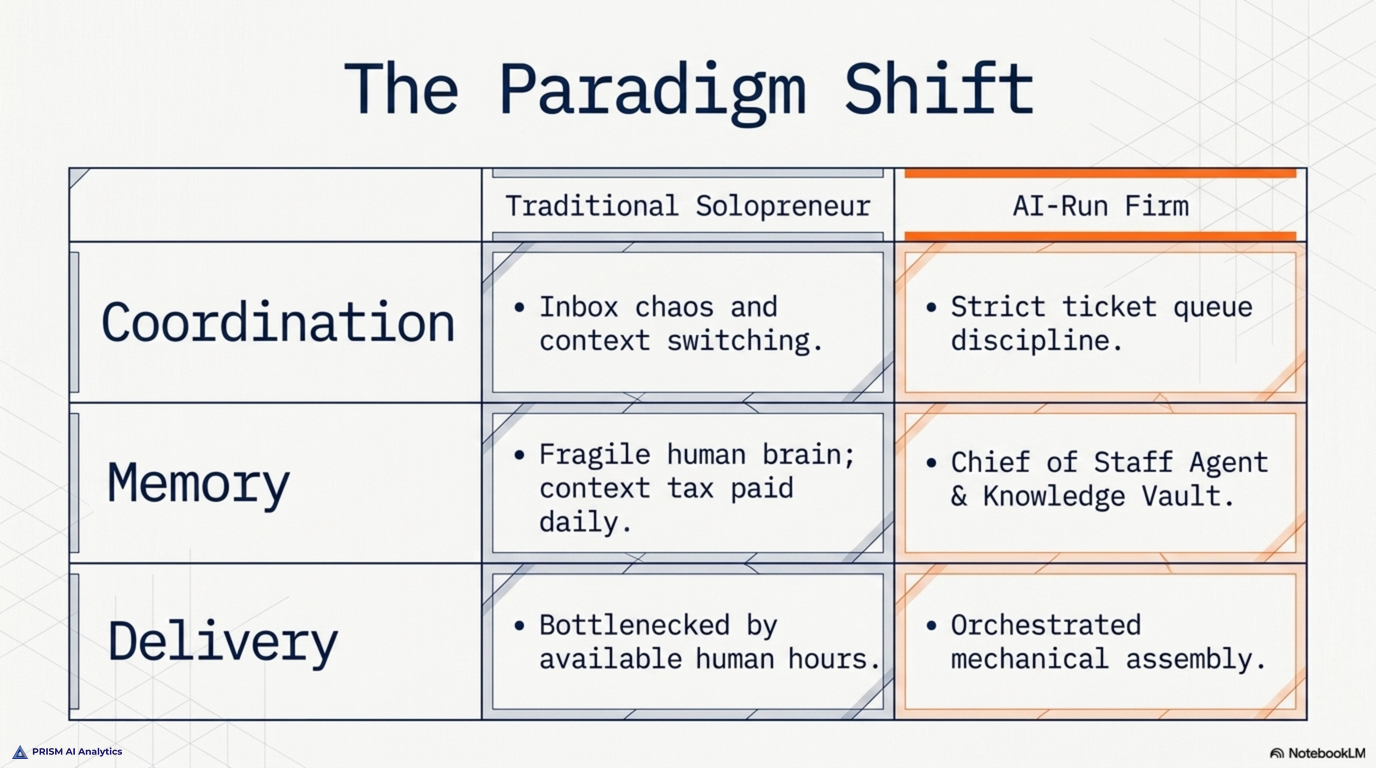
You do not need a platform, a data team, or a transformation program to run this way. Prism is proof at the smallest possible scale: the coordination layer is a ticket queue, the memory is a set of files with rules, the agents are hired one job at a time, and the human stays in charge of every decision that matters.
The honest sequence for a business that wants this: start with one repetitive job, give it to one agent, put a review gate in front of anything that touches a customer or a dollar, and keep a log. Add the second agent only when the first one has earned its keep. That is the entire methodology, and the hardest part is the discipline, not the technology.
If you want to know where your own operation stands, our free AI readiness self-assessment scores you across the same six dimensions we use in paid engagements — data, workflow, team, tooling, governance, and strategy — and takes about ten minutes. No call required, no follow-up sequence. It is the same front door our clients walk through.
The firm you just read about is one person and a queue of well-supervised agents. That is not the future of small-business operations. As of this July, it is just Tuesday.