A letter from the founder.
I run a company that operates on artificial intelligence. A few weeks ago, at my own dinner table, I could not explain it to my family.
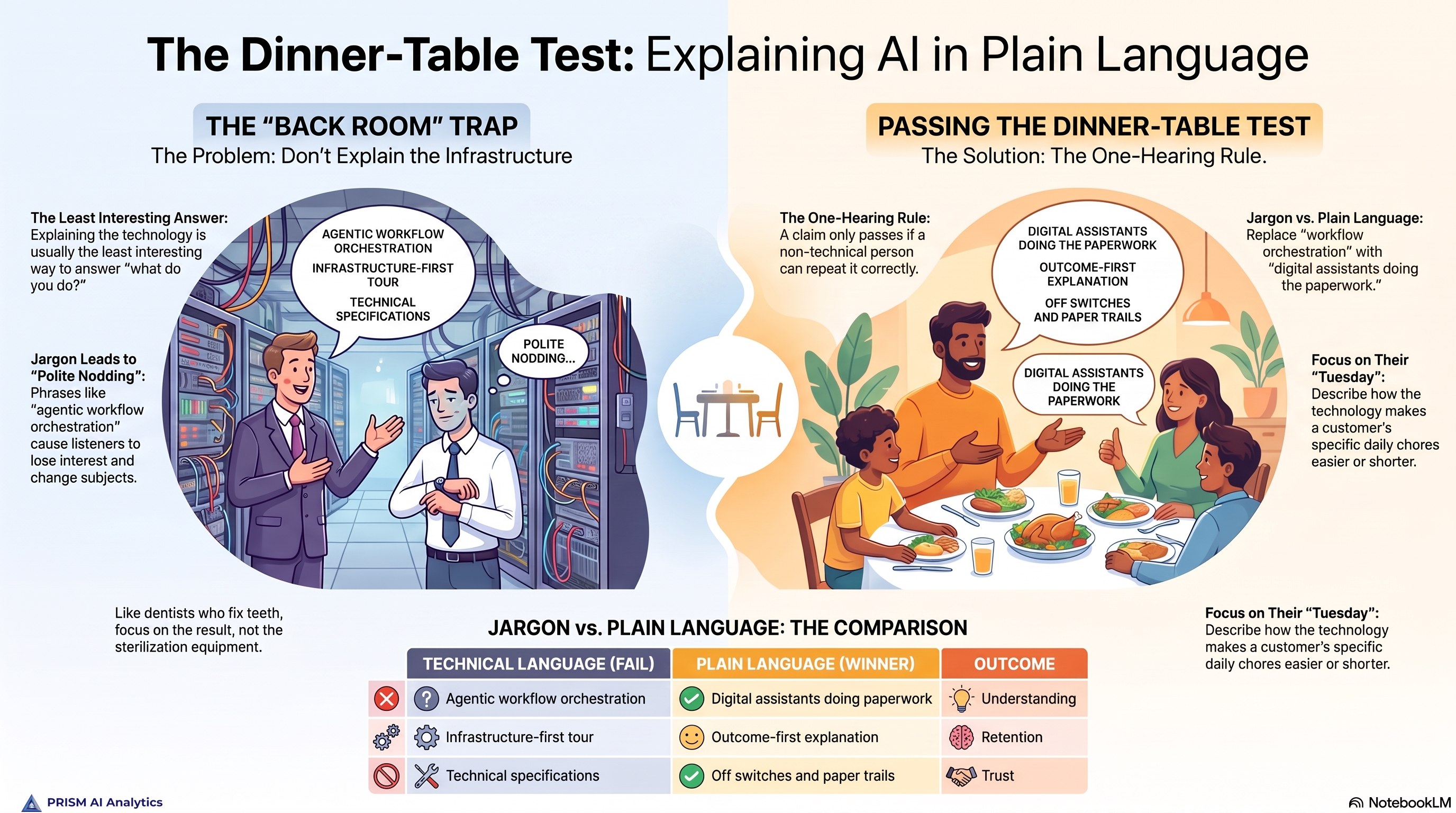
Not because they aren’t sharp — they are. And not because I don’t know my own business. I tried the honest version: the systems, the scheduled routines, the way work gets tracked and reviewed and approved. I watched the same thing happen that happens in every room where somebody explains AI: polite nodding, and then the subject changed.
I have heard the mirror image of that dinner from dozens of people since. It is the single most common sentiment I encounter: AI just doesn’t appeal to me. I don’t get it, and honestly, I don’t care to. These are capable people running real businesses. The industry has decided they are behind. They are not behind. We have been speaking the wrong language.
What I got wrong
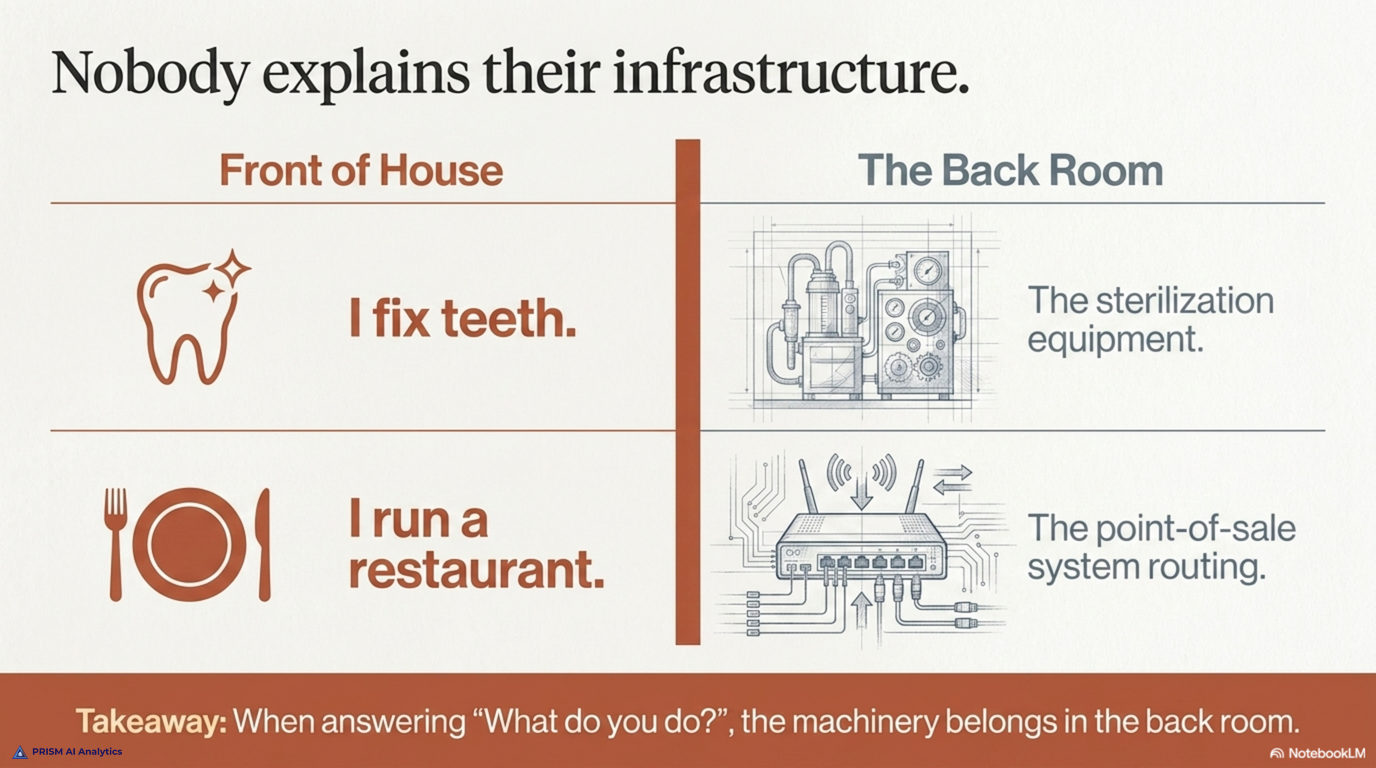
Here is what I finally noticed: nobody explains their infrastructure.
A dentist does not explain the sterilization equipment. A restaurant owner does not walk you through the point-of-sale system. When someone asks what they do, they say "I fix teeth" or "I run a restaurant," and the machinery stays in the back room where it belongs.
I was answering "what do you do?" with a tour of the back room. The technology — the part I find genuinely interesting — was the least interesting possible answer to the question actually being asked, which was: what does it do, and who pays you for it?
The sentence
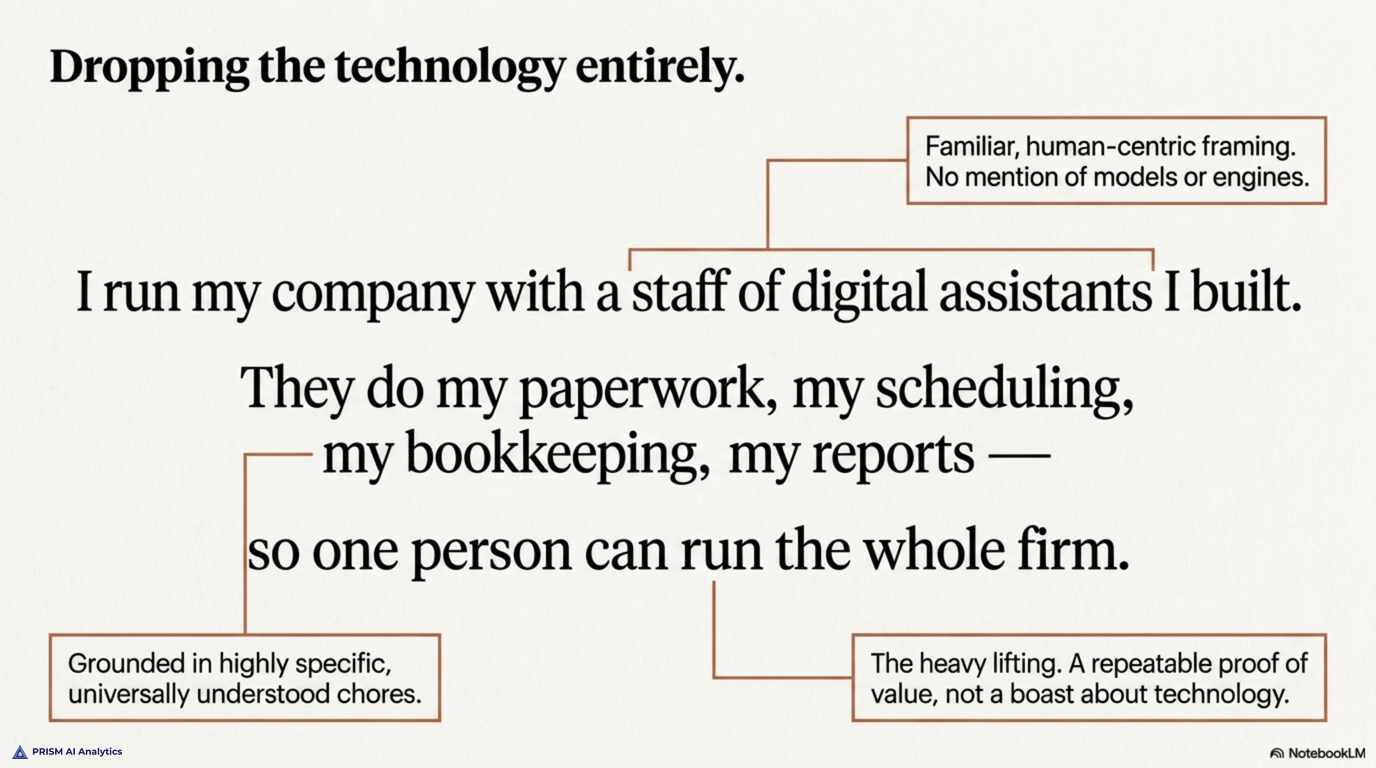
So I dropped the technology from the sentence entirely. What was left:
"I run my company with a staff of digital assistants I built. They do my paperwork, my scheduling, my bookkeeping, my reports — so one person can run the whole firm. And that’s what I sell: I set up the same kind of staff for other small business owners."
That one worked. Not because it is clever — because every word in it survives one hearing. Staff. Paperwork. Reports. One person running a whole firm. My family could repeat it back the next day, in their own words, correctly. One of them repeated it to somebody else.
That is the bar, and it turns out to be a demanding one. "Digital assistants doing the paperwork" passes. "Agentic workflow orchestration" does not — and I say that as someone who has written the second phrase in professional documents without blinking.
We made it a rule
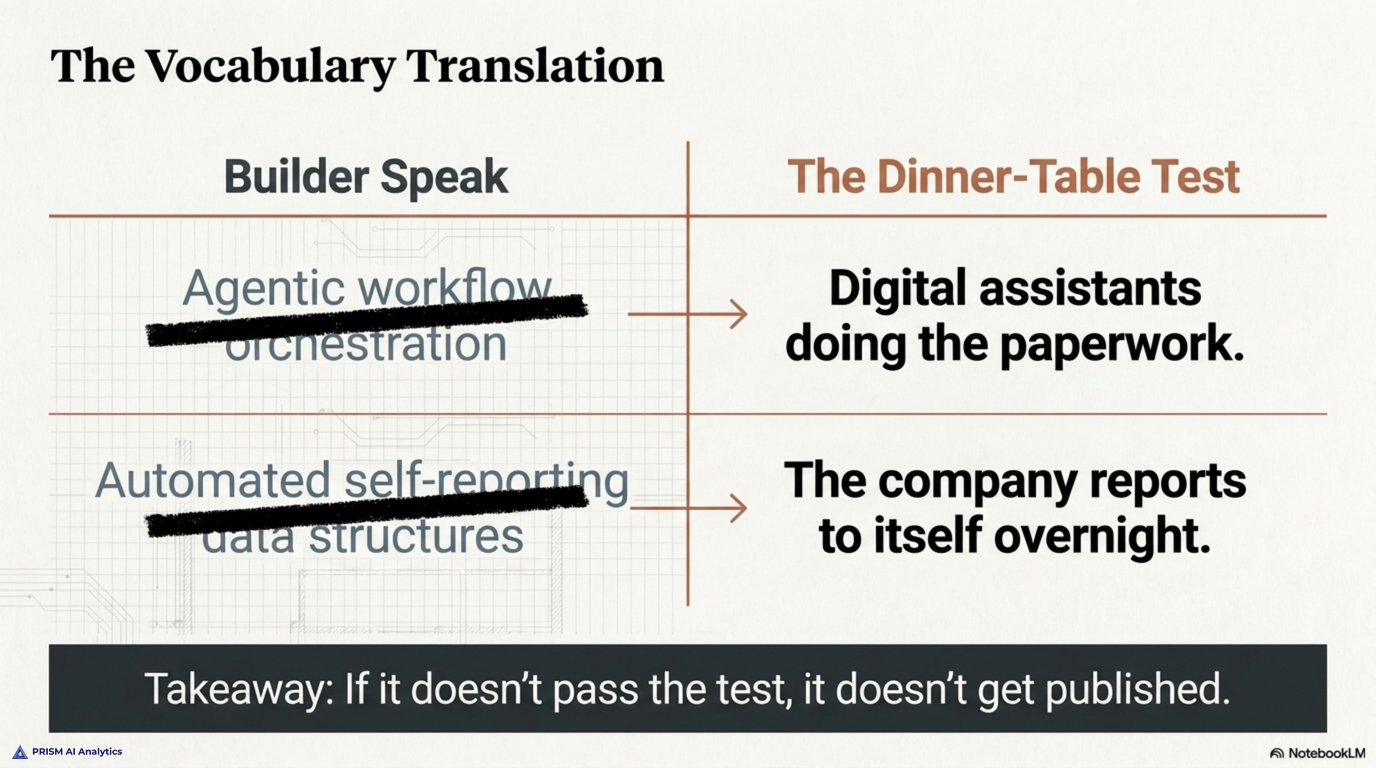
At Prism we now call this the dinner-table test, and as of this week it is a formal writing rule at the firm, sitting right next to our list of banned consultancy phrases: a claim passes when a non-technical person can repeat it to someone else after one hearing. Our website copy, our outreach, the way we open a talk — all of it gets held to that standard now.
The deeper reason is not marketing. It is respect. The people who tell me AI doesn’t appeal to them are not failing to understand the technology. The technology has been failing to explain itself in terms of their Tuesday. When I say "every morning a ranked list of the ten things that matter is waiting before I wake up, because the company reported to itself overnight" — nobody’s eyes glaze. That is somebody’s actual Tuesday getting shorter. And the part of the sentence that does the heavy lifting is the plainest one: one person runs the whole firm. That is not a boast about technology. It is the most repeatable proof I have.
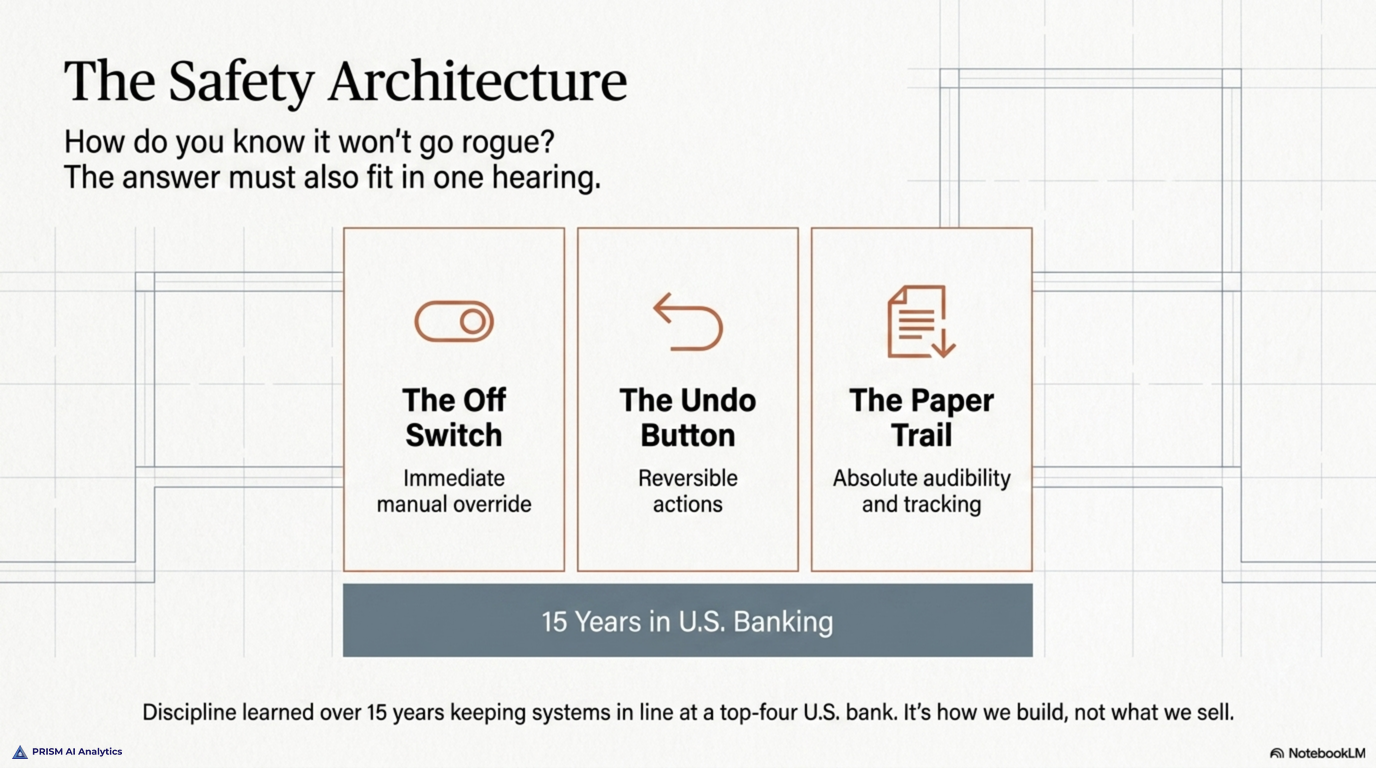
And when the safety question comes — it always comes, usually phrased as how do you know it won’t go rogue? — the answer also fits in one hearing: everything we build has an off switch, an undo button, and a paper trail. I learned that discipline over fifteen years keeping systems in line at one of the four largest U.S. banks. It is how we build, not what we sell.
If this is you
If you are one of the millions of people nobody has managed to explain AI to in words you would repeat — that is not your failure. AI is trendy right now, and I will admit the trend excites me. But what excites the builder does not excite the room — least of all the people for whom every trend so far has meant one more system to relearn. You do not need to find any of this trendy. You do not need to learn a vocabulary. The only question worth your time is the one my family’s version of the sentence ends with: which chore would you hand off first?
If you want a real answer to that, our free self-assessment is a fifteen-minute check-up that shows where digital help would save you the most time. It is written in plain language. It passed the dinner-table test before we shipped it — and everything we publish from here on will have to.
— Michele