The price of producing analysis has collapsed. Any business owner with a twenty-dollar AI subscription can now get a chart, a sales forecast, and a confident paragraph explaining both — work that used to require an analyst on payroll or a consulting invoice.
That is genuinely good news, and this is not an article arguing otherwise.
But at Prism there is a question asked of every number before it is allowed anywhere near a decision, and it is the question this new abundance makes urgent rather than obsolete: who vouches for it? Not who produced it — production is cheap now. Who checked it against the real books, who knows where the data behind it is unreliable, and who is willing to put their name on it when the bank, the accountant, or the tax office asks how it was calculated.
Call it the vouching question. Businesses that can answer it are about to pull away from businesses that cannot.
The floor dropped, and that part is good news
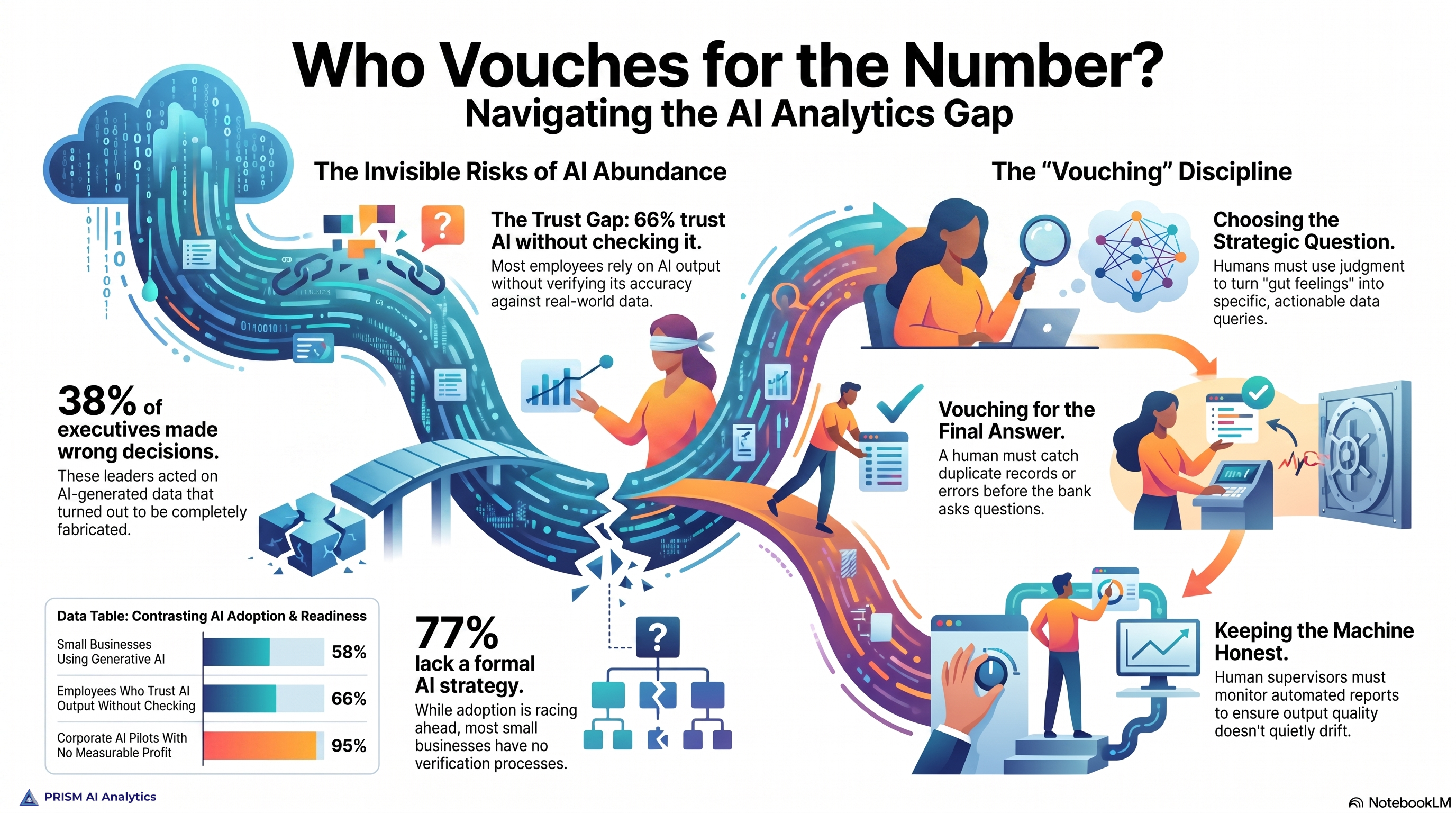
For decades, real analytics was an enterprise product. Small businesses did not have analysts; they had a bookkeeper, a gut feel, and whatever their point-of-sale system printed. AI changed that in about two years. The U.S. Chamber of Commerce reports 58 percent of small businesses now use generative AI, up from 40 percent in 2024 — and the share using it inside an actual business process nearly doubled in the same window.
So the claim that "analytics is no longer a specialty" is half right. The floor — writing queries, assembling dashboards, summarizing a spreadsheet — has commoditized, and it is not coming back. Small businesses have access to something they never had before.
What the adoption statistics do not show is what happens to the answers after the machine produces them.
What the adoption numbers are hiding
A global study by KPMG and the University of Melbourne found that 66 percent of employees trust AI output without checking it — and more than half reported workplace mistakes caused by relying on it. A Deloitte survey of executives put a sharper point on it: 38 percent said they had made an incorrect business decision based on AI output that turned out to be fabricated.
And at the project level, MIT’s State of AI in Business research found that 95 percent of corporate AI pilots produced no measurable profit impact. The failures did not trace to weak models. They traced to the unglamorous parts: the AI was never wired into how the business actually works, and the data underneath it was never made trustworthy.
Put those together and the pattern is clear. The dangerous failure mode of AI analytics is not a missing answer. It is a confident wrong answer that nobody checked — formatted well enough to look like institutional authority, delivered fast enough to beat anyone’s skepticism, and wrong in a way that only surfaces after the decision is made.
Among small businesses the exposure is wider still: of the majority now using AI, 77 percent report no formal approach to it at all, and fewer than a quarter have had any training. Adoption is racing ahead of verification, and the gap between them lands on the owner.
The three jobs the machines did not take
None of this means humans are leaving analytics. It means the human jobs are moving up a level — and the labor data agrees. Gartner’s 2026 analytics predictions found 45 percent of data teams expanding against only 8 percent shrinking, with the growth concentrated in new supervisory roles: people who design, direct, and check automated analysis rather than producing it by hand.
Three of those jobs matter to every business, whatever its size.
Choosing the question. AI is remarkable at answering questions and unremarkable at knowing which question changes a decision. Turning "revenue feels soft" into the three specific comparisons that reveal why — that is judgment built from years of seeing how businesses actually break, and no subscription includes it.
Vouching for the answer. Someone has to know the data well enough to say "this number is right" — and to catch the column that lies, the duplicate records, the report that silently excludes refunds. As the volume of machine-produced analysis grows, the person who can verify it becomes more valuable, not less.
Keeping the machine honest. When AI runs analysis on a schedule — the daily report, the weekly forecast — someone has to notice when its output quietly goes bad, because it will not announce it. This job barely existed three years ago. It is the fastest-growing of the three.
What this looks like in practice
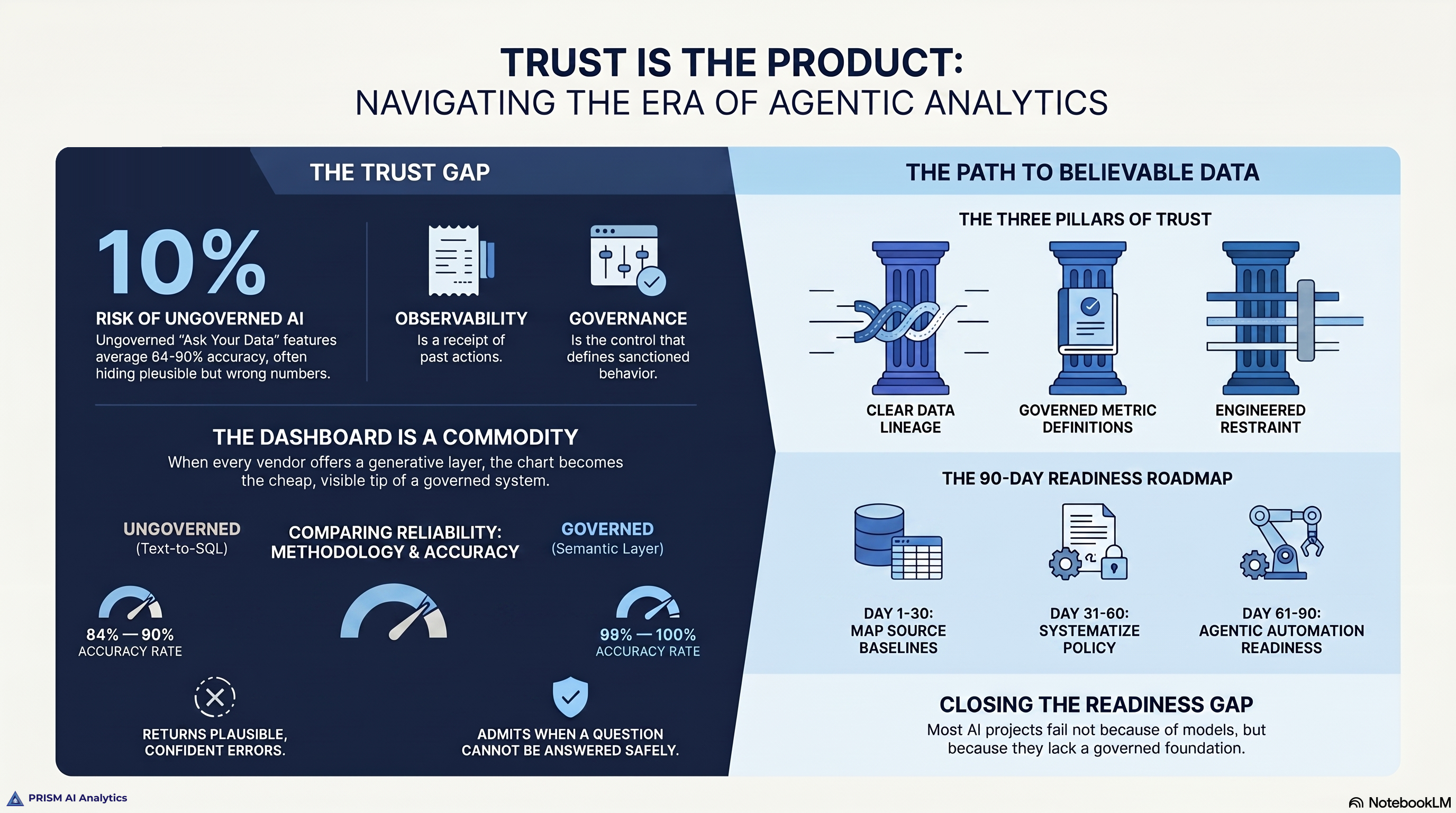
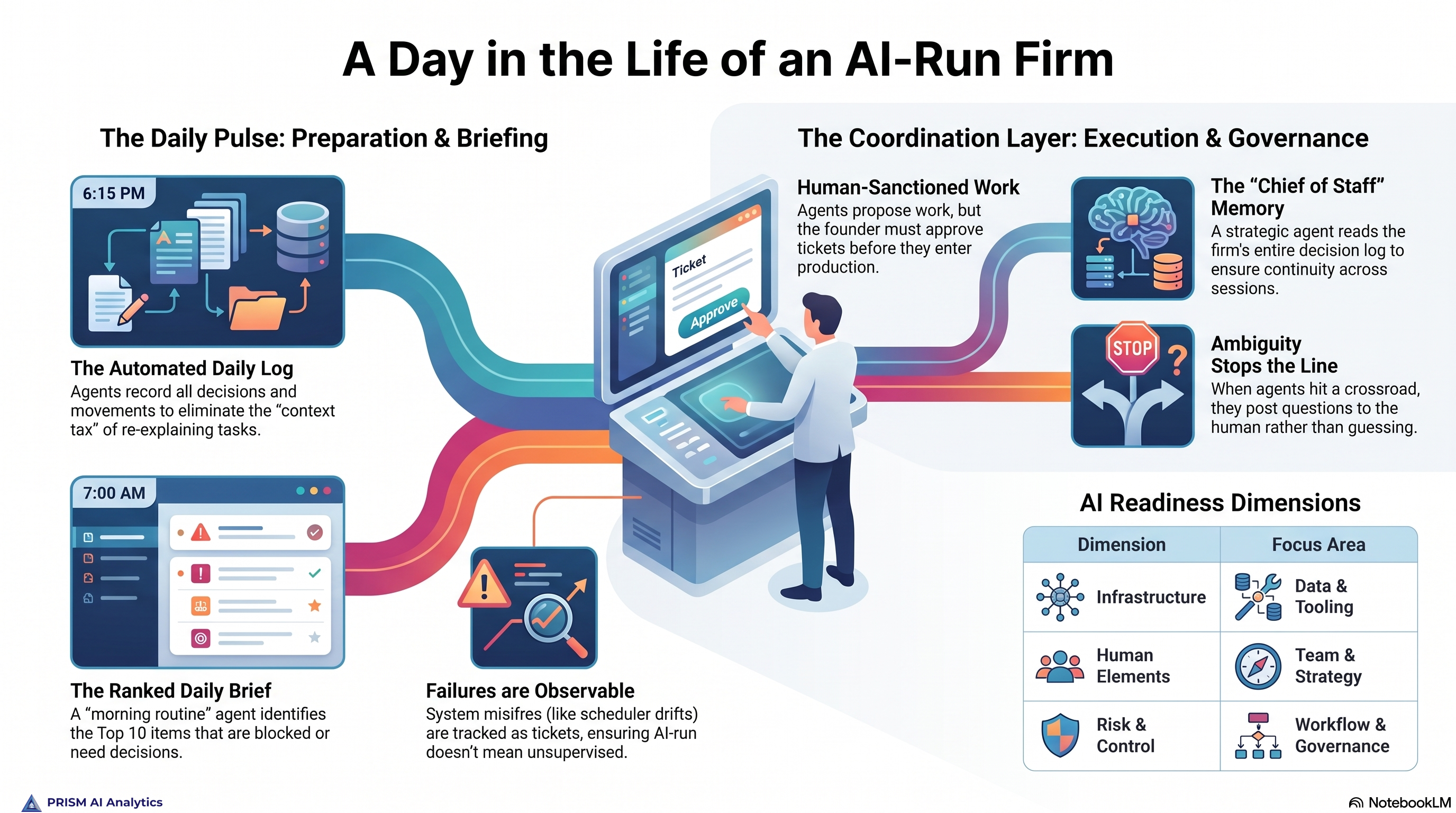
Prism operates this way because Prism runs this way. The firm is operated by a staff of digital assistants — they do the paperwork, the scheduling, the bookkeeping, the reports — and every one of them works under the same discipline offered to clients: a recorded definition of what the assistant is supposed to do, checks that catch it drifting from that definition, and a human who reviews and signs before its work touches a real decision.
That last part is the point. The digital staff produces the number; a person vouches for it. Remove the vouching and what remains is the 66-percent problem — trust without checking, at business speed.
For a small business owner, the practical version is three questions worth asking about any AI-produced number before acting on it:
- Would this number survive being checked against the actual books?
- Does anyone here know where our data is wrong — and did they see this before it reached me?
- If a lender or auditor asked how this was calculated, is there an answer beyond "the AI said so"?
If the answer to all three is yes, the business has something rare: analytics it can act on. If not, the business does not have analytics — it has plausible sentences.
Where this article came from
One more thing, in the interest of practicing what is being preached: this article did not start as a content plan. It started as a strategy question asked inside Prism — by the founder, a data engineer turned AI consultant, looking at the same headlines everyone else sees and asking the uncomfortable version out loud: is the profession my career was built on dissolving under the technology my firm now sells?
The question did not go straight to a conclusion. It went to research first — labor projections, adoption surveys, trust studies — pulled from primary sources, checked, and logged before a single sentence of this piece was written. The position came out the other side of the evidence, not ahead of it.
That is the discipline this article is arguing for, applied to the firm’s own future. Industries do not send a memo when they shift; staying aligned with one is a standing habit of asking the hard question, vouching for the answer, and being willing to change your own job description when the evidence says so. A career that moved from building data pipelines to running an AI-operated firm is what that habit looks like over fifteen years — and the same habit is what a business of any size needs now that the charts come cheap.
The question that separates
AI did not make analytics less important. It made unverified analytics abundant — and abundance of the unverified is exactly what makes verification scarce, and scarcity is where value lives.
So the businesses that stand out over the next few years will not be the ones producing the most charts. Everyone will produce charts. They will be the ones that can answer, calmly and immediately, the question this whole era turns on:
Who vouches for the number?
*Prism AI Analytics builds AI-run operations for small businesses — ours included. The AI Readiness Assessment is where most engagements start: a check-up that shows where digital help would save you the most time, and where your numbers need a second set of eyes first.*