For thirty years the dashboard was the deliverable. A business asked a question, an analyst built a chart, and the chart went on a screen someone checked on Monday. The chart was the work. Building it was slow enough, and skilled enough, that owning a good one was a small competitive advantage.
That era is closing. In 2025 every major analytics vendor shipped the ability to produce a chart, or answer a data question in plain language, in seconds and without an analyst in the loop. When the chart becomes free, it stops being the asset. What is left — the only thing that was ever actually valuable — is whether the number on the chart is one you can stake a decision on.
That is the shift worth understanding. The value in business intelligence is migrating from the artifact to the trust underneath it. The firms that adjust will treat a dashboard as the cheap, visible tip of a governed system. The firms that do not will keep paying for charts while the decision-making problem they actually have goes unaddressed.
What every vendor shipped this year
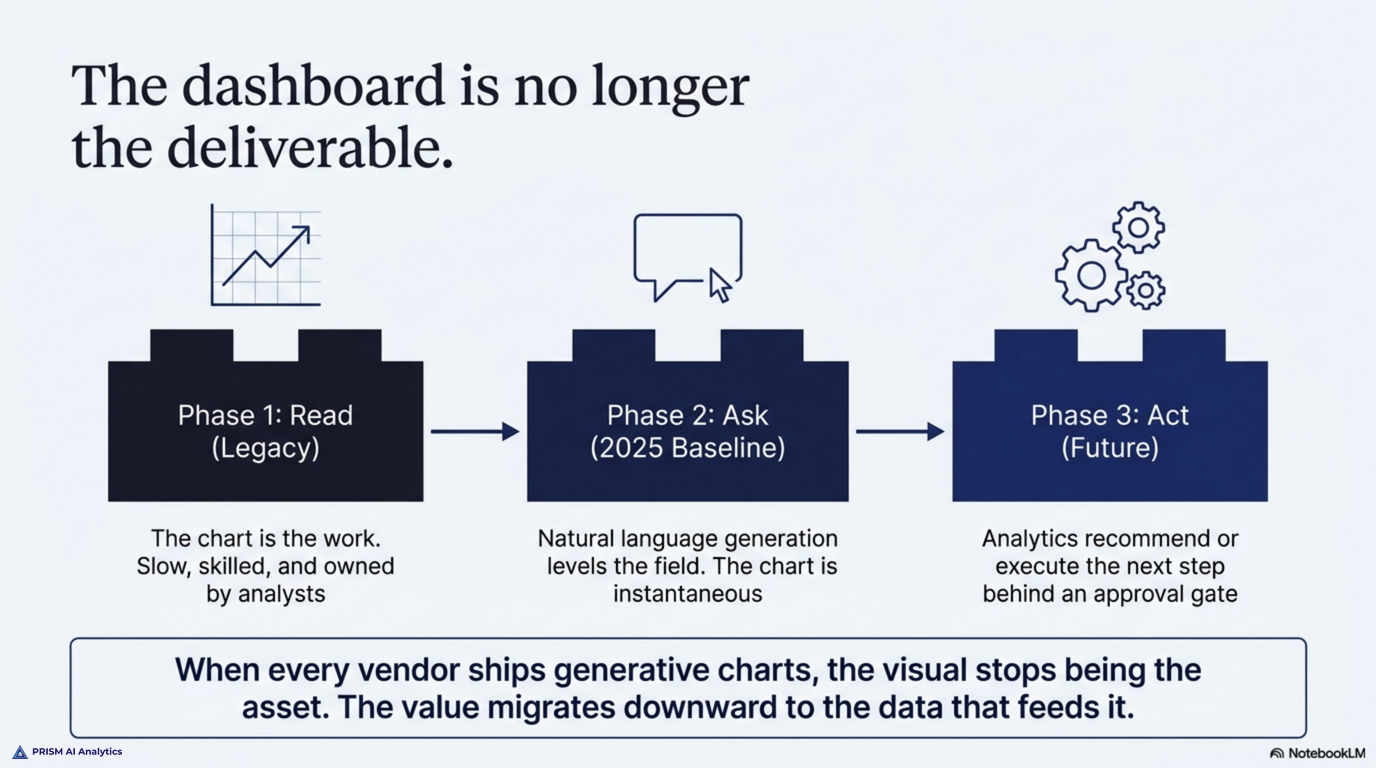
The pattern across the industry is a progression: from dashboards you read, to interfaces you ask, to agents that act.
Salesforce launched Tableau Next, branded an agentic analytics platform, with agents that answer questions, build the underlying data model, and monitor metrics continuously. Microsoft kept expanding Power BI Copilot into natural-language questions on the desktop and the phone. ThoughtSpot put an agent in front of the whole platform. Google brought conversational analytics into Looker on its Gemini models, and Amazon added an agentic mode to Q in QuickSight.
Read past the announcements and the message is the same: producing a chart or answering a question is now table stakes. It is something the tooling does. It is not where the differentiation lives anymore.
It is worth being precise about what this does and does not mean. The dashboard is not dead — that is a vendor slogan, not an observation. Forrester’s read is more honest: generative AI is not replacing business intelligence; it is leveling the field, because every vendor now has the same generative layer. When a capability is everywhere, it stops being a reason to choose one provider over another. The dashboard does not disappear. It commoditizes.
The problem the demos do not show
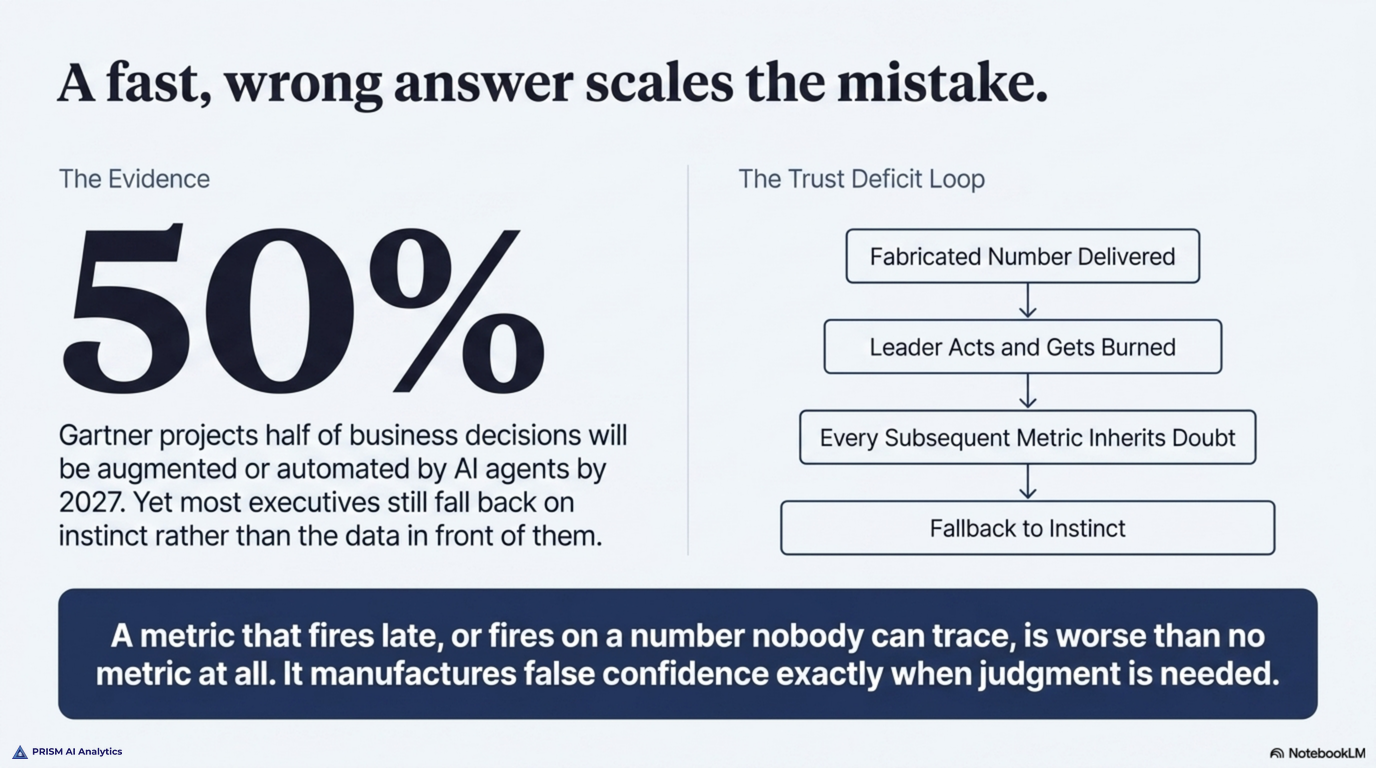
Ask a plain-language question of your data and get an instant answer, and the demo looks like magic. The problem is the answer you cannot see being wrong.
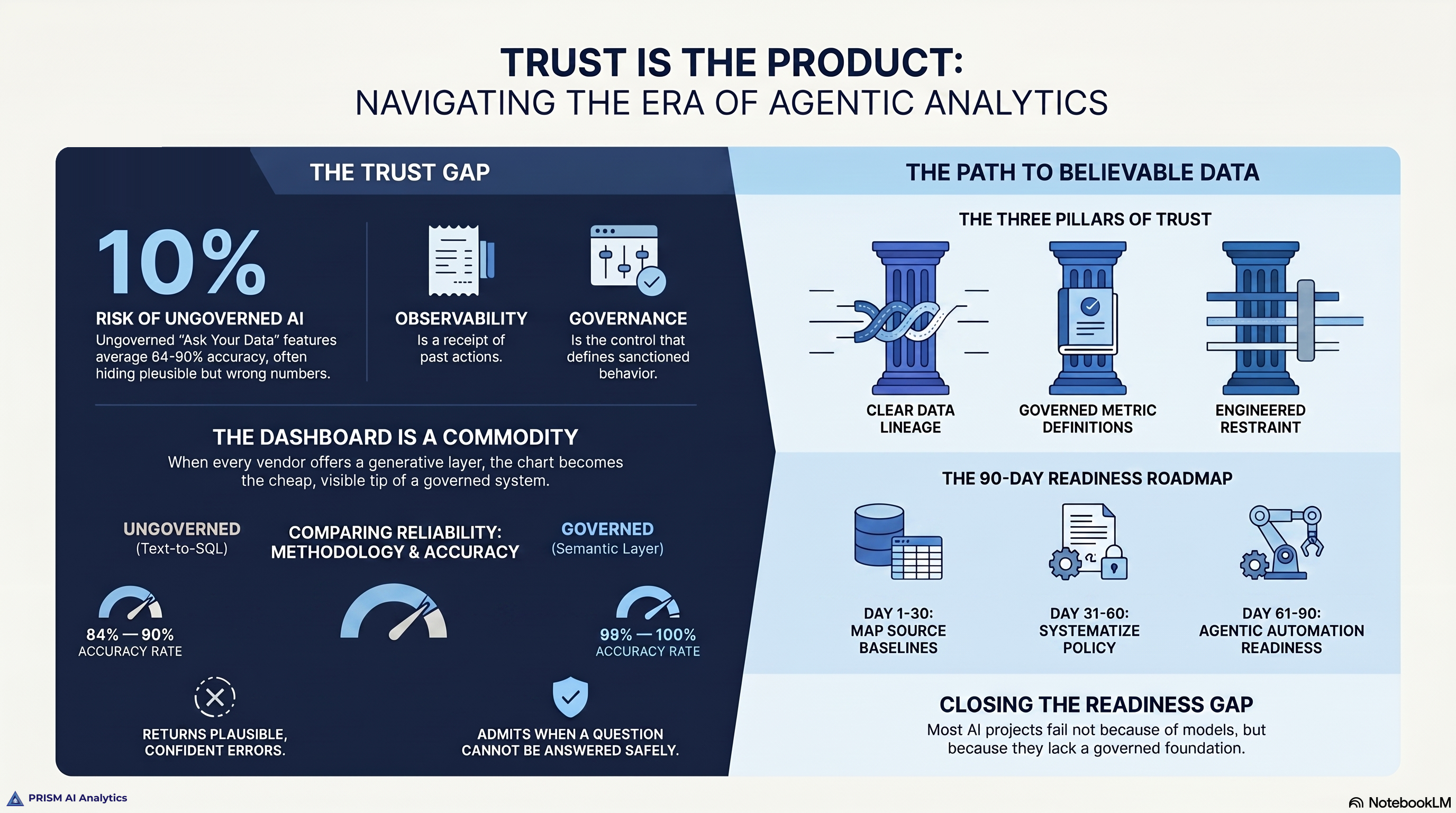
A 2026 benchmark from dbt Labs put numbers on this. Asking a large language model to translate a business question directly into a database query — the technique under most "ask your data" features — reached roughly 84 to 90 percent accuracy. That sounds high until you sit with what the other ten to sixteen percent does. It does not announce itself. It returns a plausible, confident, wrong number, in the same tone as a correct one. The same benchmark found that routing the question through a governed definition of the business’s metrics instead reached 98 to 100 percent — and, more importantly, said so when a question fell outside what it could safely answer.
That gap is the whole problem in one line. An ungoverned AI guesses and hides the guess. A governed one knows what it does not know and tells you.
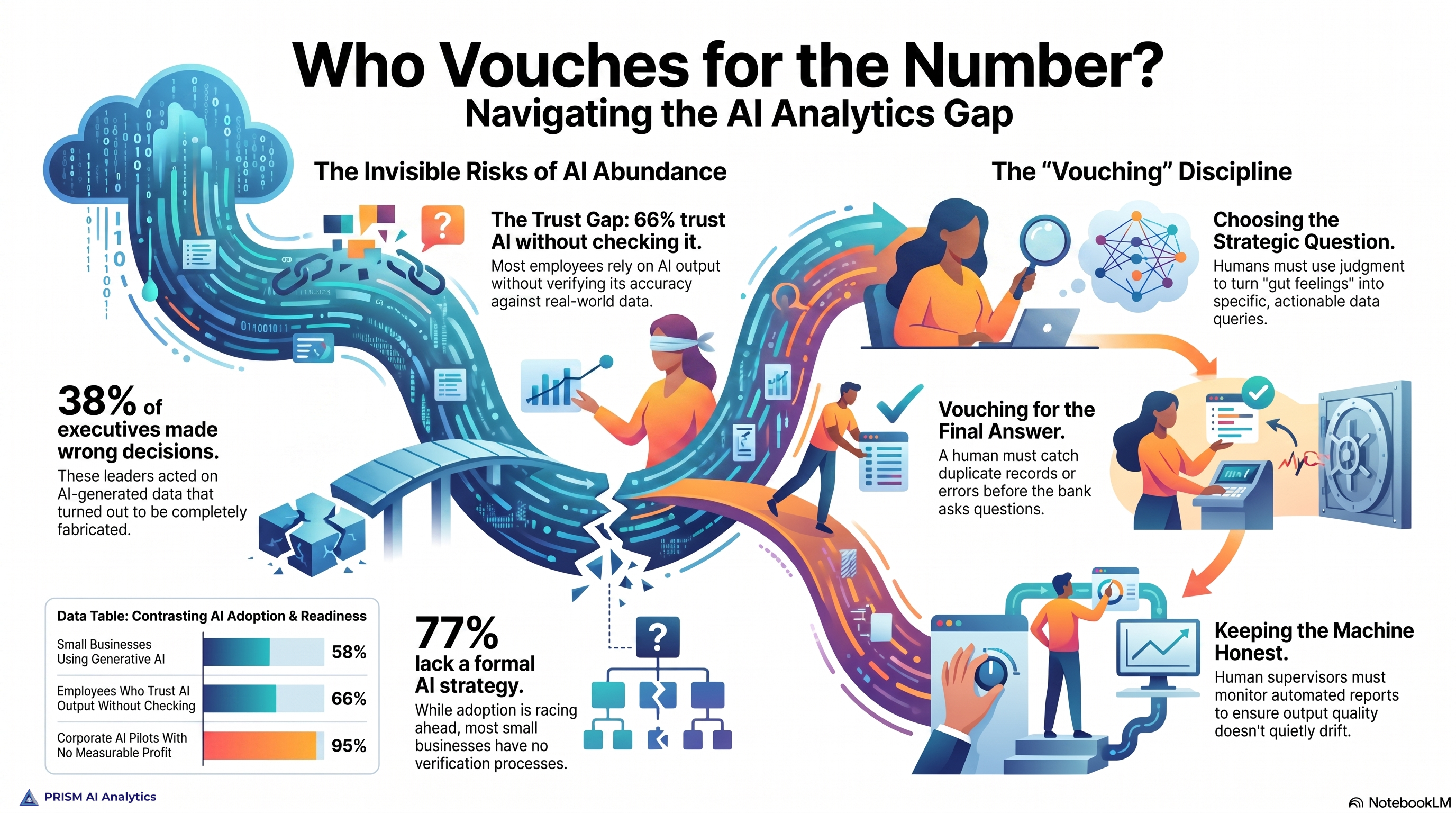
This is not a hypothetical risk to a decision-maker. Gartner has found that most executives still fall back on instinct rather than the data in front of them, and the reason is not stubbornness — it is a trust deficit. A confident wrong answer, delivered fast, does not close that deficit. It widens it. The first time a leader acts on a fabricated number and gets burned, every number after it inherits the doubt.
I spent the first part of my career inside one of the four largest U.S. banks building the operational risk metrics that flagged exposures before they became losses. A metric that fires late, or fires on a number nobody can trace, is worse than no metric at all — it manufactures false confidence at exactly the moment judgment is needed. The first thing you build is never the chart. It is the assurance that the number is real. That discipline did not come from the AI era. It is what the AI era is now rediscovering.
Trust is the product
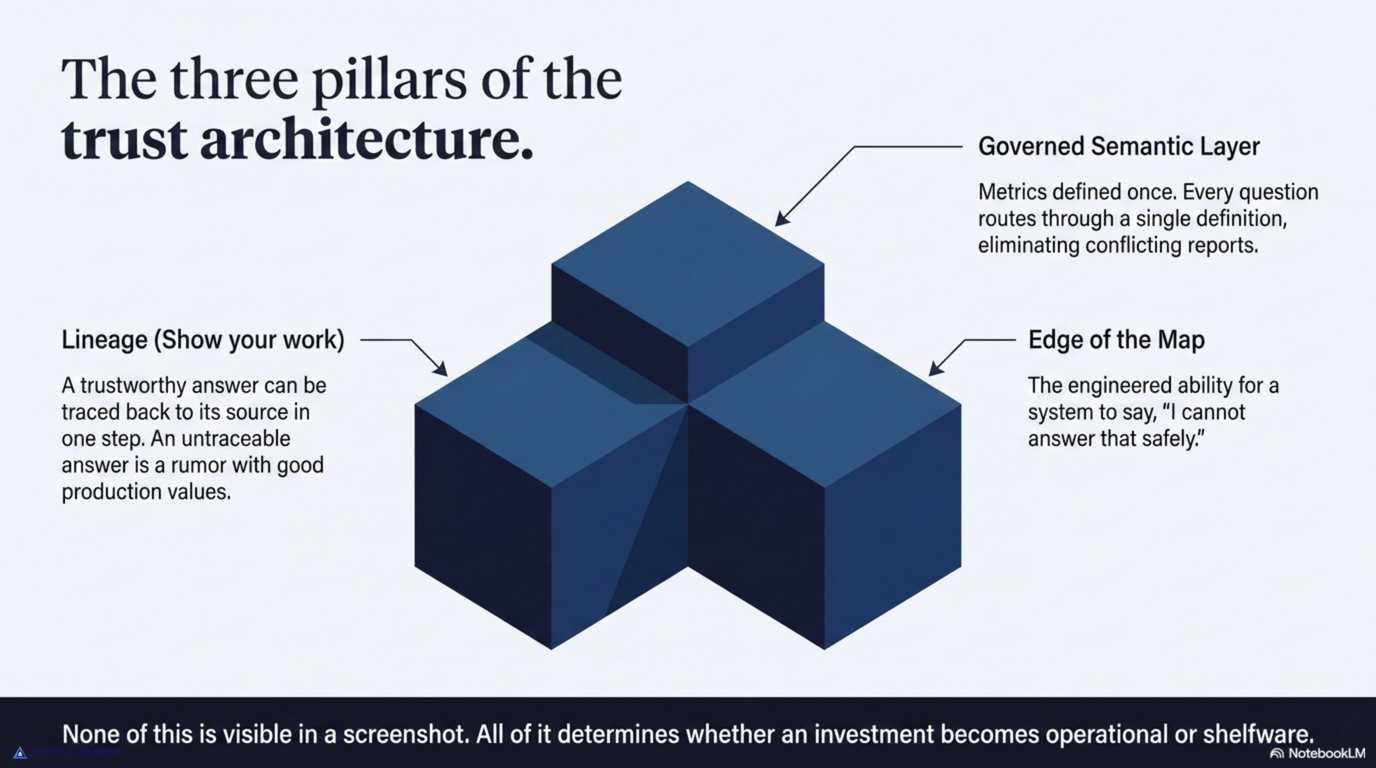
If the chart is the commodity, the product is everything that makes the chart believable. Three things matter, and they are the same three whether the stakeholder is a founder, an operator, or a board.
Lineage — show your work. A trustworthy answer can be traced back to its source in one step: which data, which definition, which calculation. An answer that cannot be traced is a rumor with good production values.
A governed definition of the metrics. Most "what is our revenue" disagreements are not data problems; they are definition problems. When five reports define revenue five ways, an AI pointed at that mess will pick one at random and present it as fact. A governed semantic layer — one place where each metric is defined once and every question routes through it — is what makes an AI answer consistent and auditable. This is why Gartner elevated the semantic layer to essential infrastructure in 2025, not a nice-to-have.
Knowing the edge of the map. The single most valuable behavior in an analytics system is the ability to say "I cannot answer that safely." It is also the rarest, because it is the opposite of what a language model is built to do. Engineering that restraint in is governance work, not modeling work.
None of this is visible in a screenshot. All of it is what separates an analytics investment that changes decisions from one that produces shelfware.
From watching to deciding
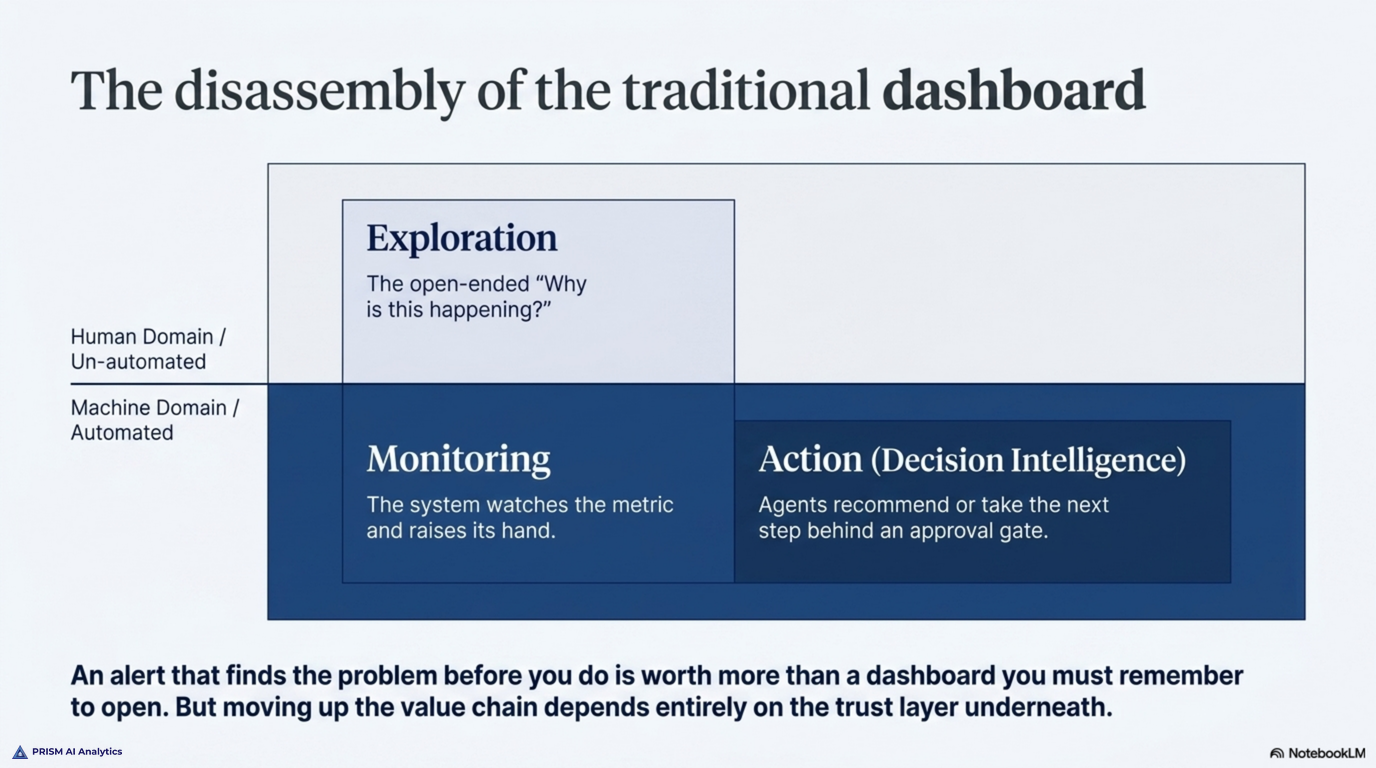
The other half of the shift is what happens after the answer. The dashboard’s traditional job — sit on a screen and wait for someone to notice something is wrong — is being pulled apart into three pieces.
Monitoring is being automated. Instead of a human checking a chart, the system watches the metric and raises its hand when something moves. Action is moving into what the industry now calls decision intelligence — analytics that recommend the next step, or, behind an approval gate, take it. Gartner expects half of business decisions to be augmented or automated by AI agents by 2027. What remains firmly human is exploration: the open-ended "why is this happening" that a dashboard supports and an agent cannot yet own.
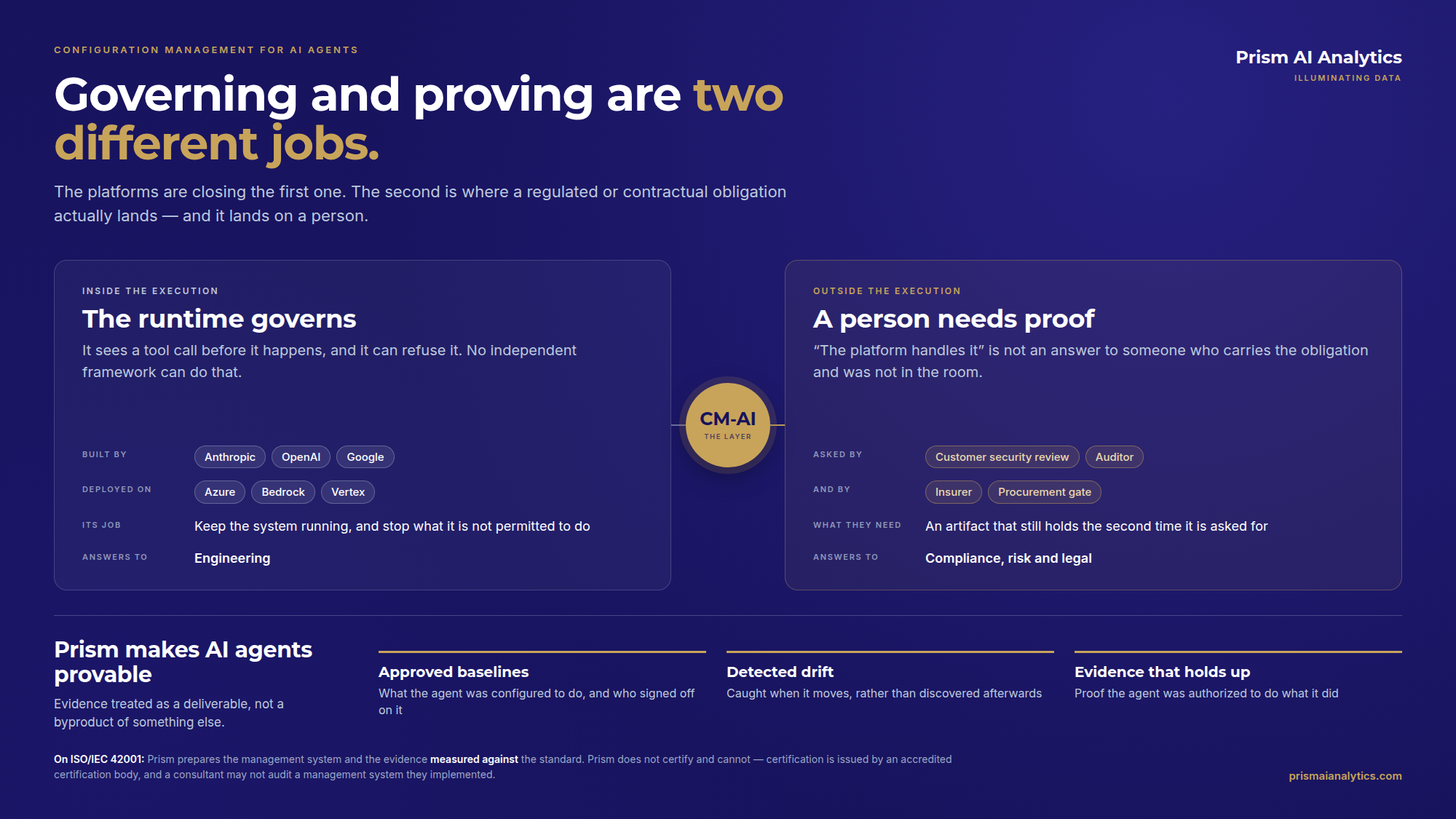
For a business, the practical translation is this. You will want fewer screens to check and more decisions made well and fast. An alert that finds the problem before you would have is worth more than a dashboard you have to remember to open. A recommendation you can trust enough to approve is worth more than a chart you have to interpret. But every one of those moves up the value chain depends on the trust layer underneath. An agent that acts on a wrong number does not save you time. It scales the mistake.
Why most of this fails, and what to do instead
The uncomfortable backdrop to every AI analytics pitch is the failure rate. Industry analysis through 2025 found that the large majority of generative AI pilots showed no measurable impact on the bottom line, and Gartner projected that organizations would abandon a majority of AI projects that were not supported by data the AI could actually use.
The pattern in those failures is consistent, and it is not the model. The tools work. What is missing is the governed data underneath them — the definitions, the lineage, the quality controls that make an answer trustworthy. The work that gets skipped because it does not demo well is exactly the work that determines whether any of it survives contact with a real decision.
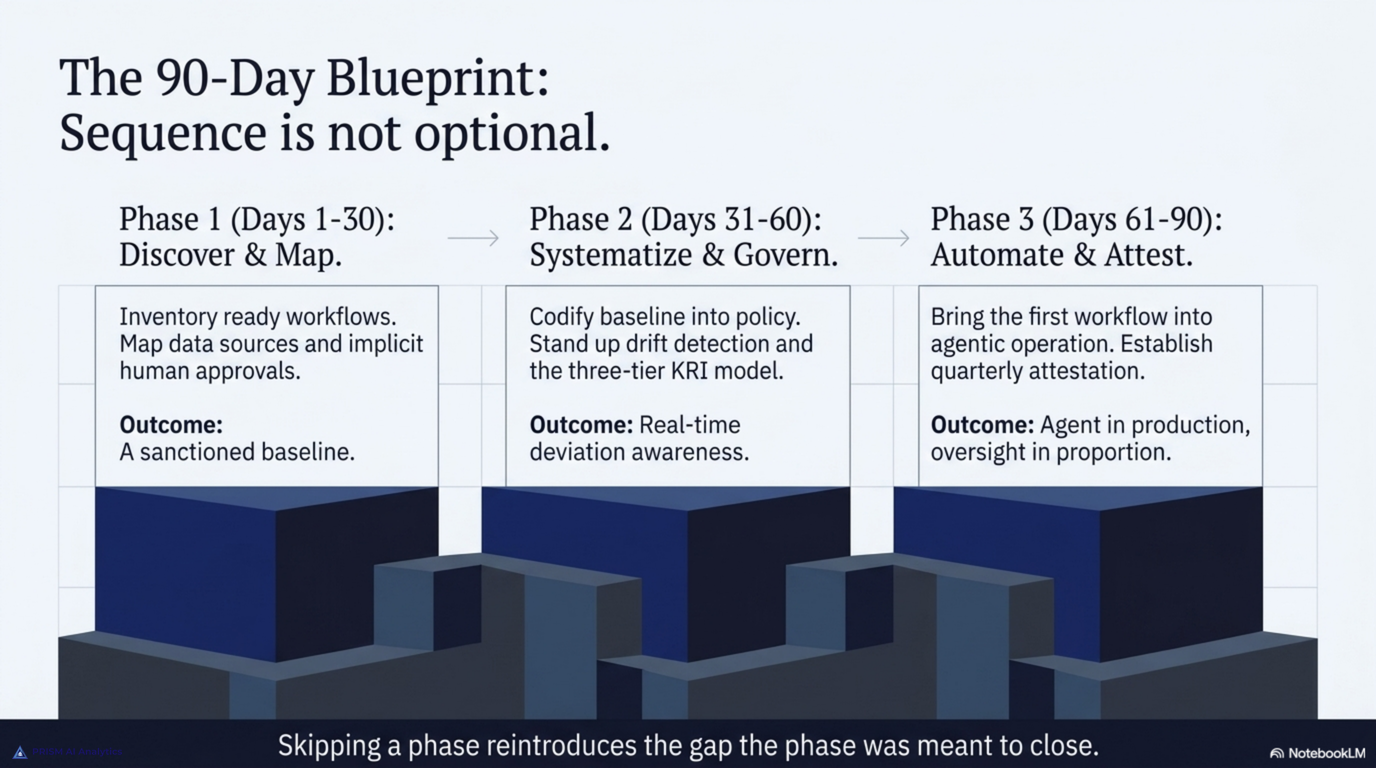
For a small or mid-market business, the lesson is not "buy the platform with the best AI." Every platform now has good AI. The lesson is to build the foundation that makes the AI safe to trust, before pointing it at the questions that matter. Diagnose readiness. Define the metrics once. Wire in the lineage. Then layer the conversational and agentic features on top, where they will actually hold.
That sequence is unglamorous, and it is the entire game. The chart is cheap now. Trust is the work. A firm that sells you a dashboard in 2026 is selling you the commodity. A firm that builds you the trusted foundation underneath it is selling you the thing that was valuable all along.
\*Prism AI Analytics builds the governed foundation that makes AI analytics safe to decide on — readiness assessment, metric definitions, and the lineage that lets a number survive an audit. If that is the layer your business is missing, start a conversation.\*
Sources cited
- dbt Labs, Semantic Layer vs. Text-to-SQL: A 2026 Benchmark. docs.getdbt.com/blog/semantic-layer-vs-text-to-sql-2026
- CIO, The end of dashboards? GenAI and agentic workflows transform business intelligence (Forrester commentary). cio.com
- Coalesce, Semantic Layers in 2025 (Gartner Hype Cycle framing). coalesce.io
- SalesforceDevops, Salesforce Unveils Tableau Next. salesforcedevops.net
- TechTarget, ThoughtSpot automates full platform with new Spotter agents. techtarget.com
- Google Cloud, Looker Conversational Analytics now GA. cloud.google.com
- Microsoft, Power BI November 2025 Feature Summary. powerbi.microsoft.com
- Technology Magazine, Gartner: AI agents will drive half of decisions by 2027. technologymagazine.com
- TechTarget, 4 trends that shaped data management and analytics in 2025. techtarget.com
- Gartner, Lack of AI-Ready Data Puts AI Projects at Risk. gartner.com
Wondering whether your data is ready for AI?
Prism AI Analytics helps small and mid-market businesses build the governed foundation that makes AI analytics trustworthy — metric definitions, data lineage, and a readiness assessment before you buy the platform.