There is a moment that arrives for almost everyone who puts AI agents to work, and it does not announce itself. You are moving fast. The agents are useful. You add one to draft outreach, another to clean data, a scheduled job that runs something every morning, a connector to your calendar, a hook that fires before a file gets written. Each addition is small and sensible on the day you make it. And then one ordinary afternoon you go to answer a simple question — what exactly is running right now, and on whose authority? — and you find that you cannot.
That gap is the subject of this post. Not how to build a fancier agent. Not which model is best. The plainer, more uncomfortable thing underneath: once you have agents acting on your behalf, faster than you can watch and in places you stopped looking, how do you stay in control of them? I have started calling this wrangling AI agents in the wild, and in my experience it is the part of the AI story almost nobody has a playbook for yet.
Wrangling is what you are already doing
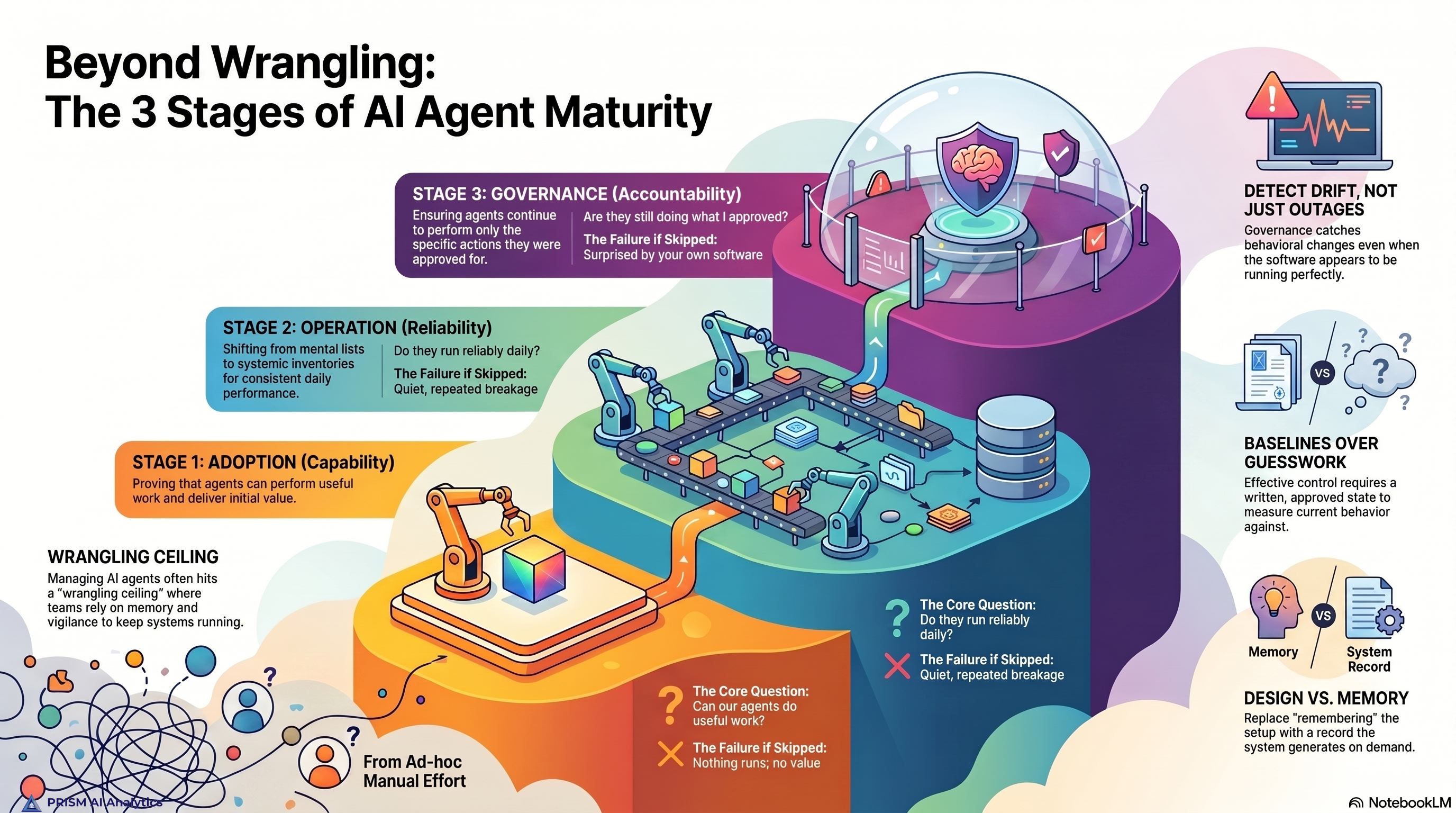
Most teams running agents today are wrangling, whether or not they would use the word. Wrangling is the ad-hoc version of control: you keep an eye on things, you spot-check the output, you remember roughly what you set up, and you fix problems when you happen to notice them. It works the way keeping track of three browser tabs works. It is fine right up until it is not.
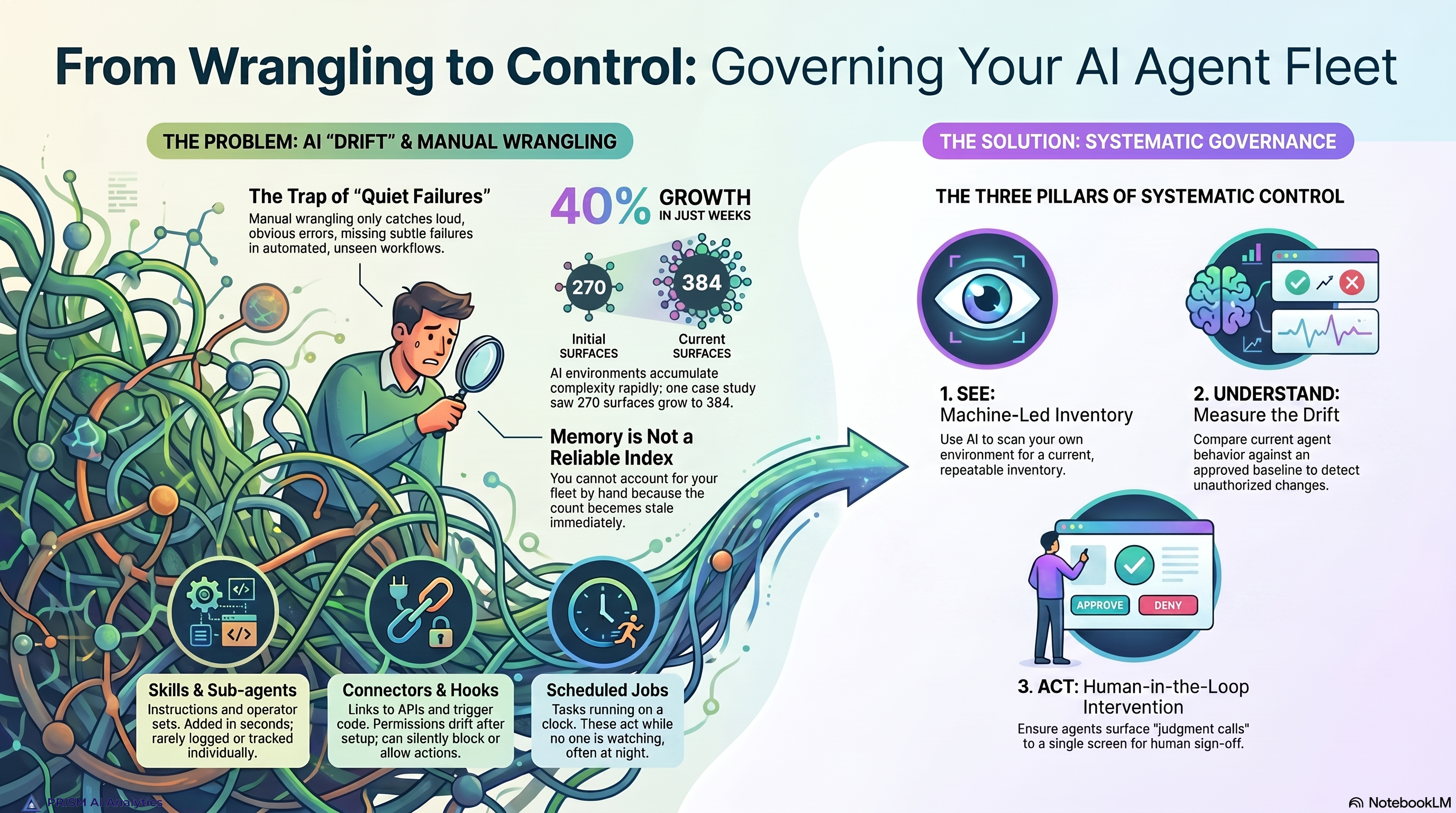
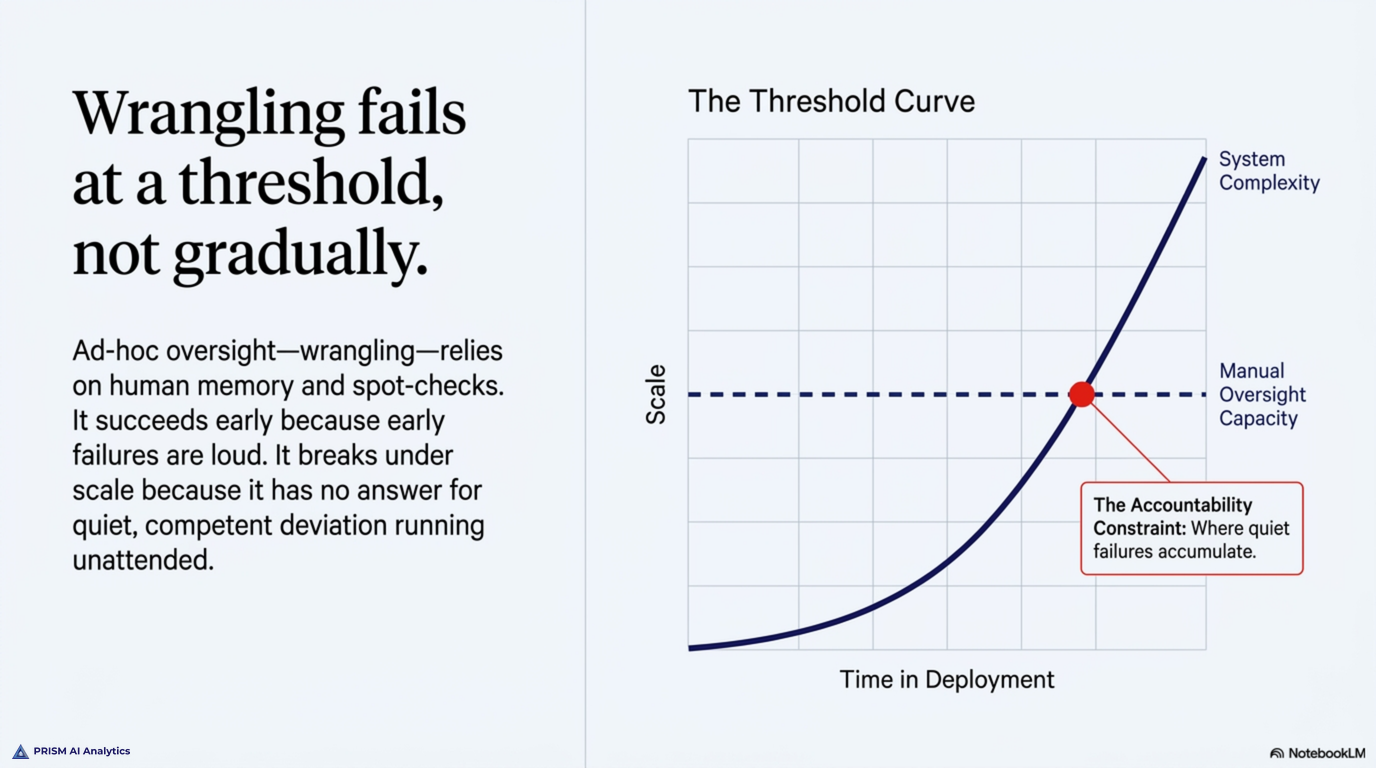
The reason wrangling feels manageable for a while is that the early failures are loud. An agent produces obvious nonsense, you see it, you correct it. The failures that should worry you are the quiet ones — the agent that does something plausible and wrong, competently, at three in the morning, in a workflow you forgot you automated. Wrangling has no answer for the quiet failure, because wrangling depends on you happening to look.
Why it sneaks up on you
The trouble is structural, not a matter of discipline. An AI environment is not one thing you can hold in your head. It is a stack of separate surfaces, each of which changes how your agents behave, and most of which can be edited without anyone signing off.
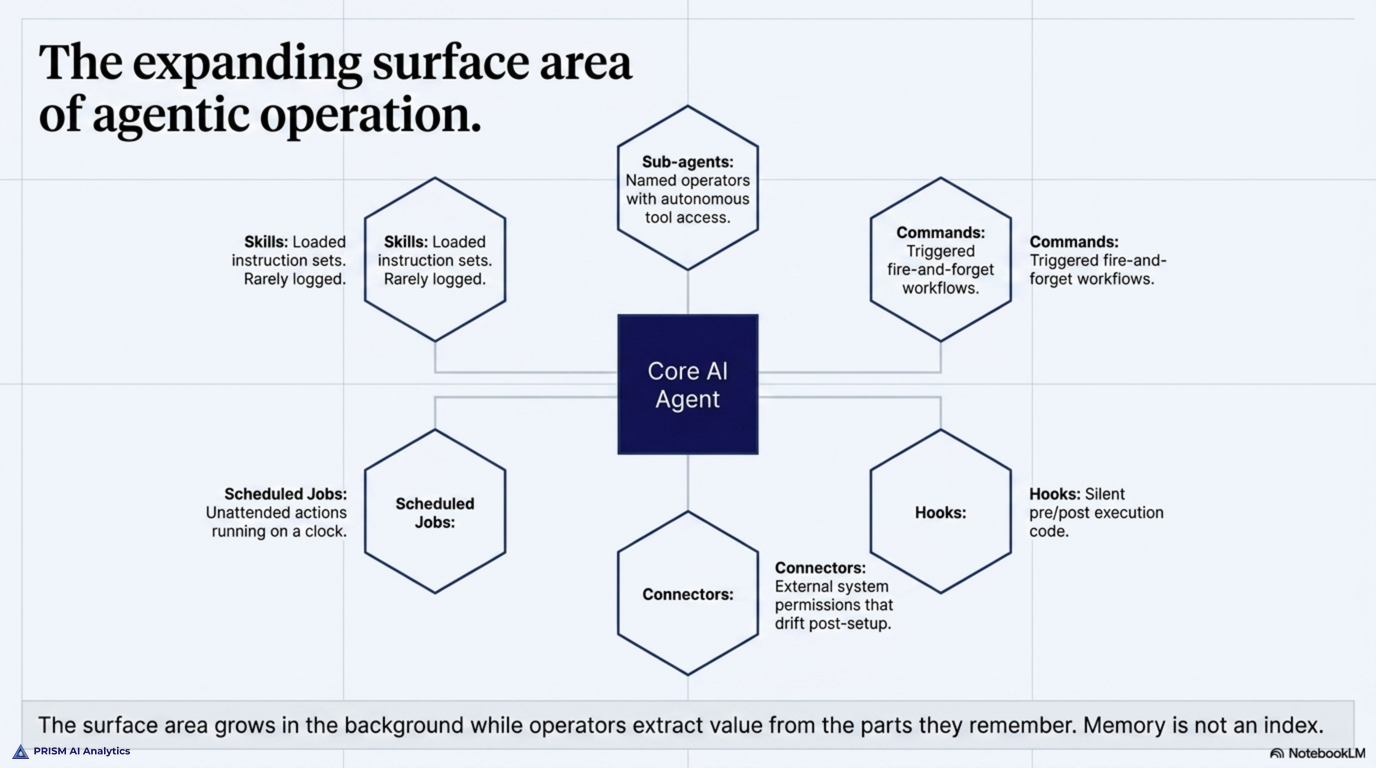
In a typical setup, the surfaces that shape how your agents behave are concrete, separate, and each editable on its own:
| Surface | What it is | Why it slips out of view |
|---|---|---|
| Skills | Instruction sets an agent loads on demand | Added in seconds, rarely logged |
| Sub-agents | Named agents with their own instructions and tool access | Each is its own small operator |
| Commands | Saved prompts that trigger whole workflows | Fire-and-forget once they work |
| Hooks | Code that runs before or after an action | Can silently allow or block things |
| Connectors | Links to outside systems — databases, paid APIs | Permissions drift after setup |
| Scheduled jobs | Tasks that run unattended on a clock | Act while no one is watching |
Any one of those can be added in a minute. None of them sends you a receipt. The surface area grows in the background while you are busy getting value out of the parts you remember.
That is the trap. The same speed that makes agents worth adopting is the speed at which your ability to account for them erodes. You are not careless. You are outpaced by your own tooling.
I had Claude count mine, and the number kept moving
I am not writing this as a security specialist. I am writing it as someone who built an AI-first firm and then had to govern the thing I had built. The first thing I needed was an honest inventory — and the detail that matters is how I got it. I did not sit down and write it out from memory. I had Claude scan my own environment and produce the list. A hand-written inventory would have been stale before I finished it and would have quietly omitted every surface I had forgotten I set up. That is the whole trouble in miniature: memory is not a reliable index of what you are running. Using the machine to inventory the machine is not a shortcut — it is the only version that stays true.
Here is what the most recent scan of my own environment actually returned:
| Surface | Count |
|---|---|
| Skills | 184 |
| Sub-agents | 48 |
| Commands | 81 |
| Hooks | 31 |
| Connectors (MCP servers) | 27 |
| Scheduled jobs | 12 |
| Plugins | 1 |
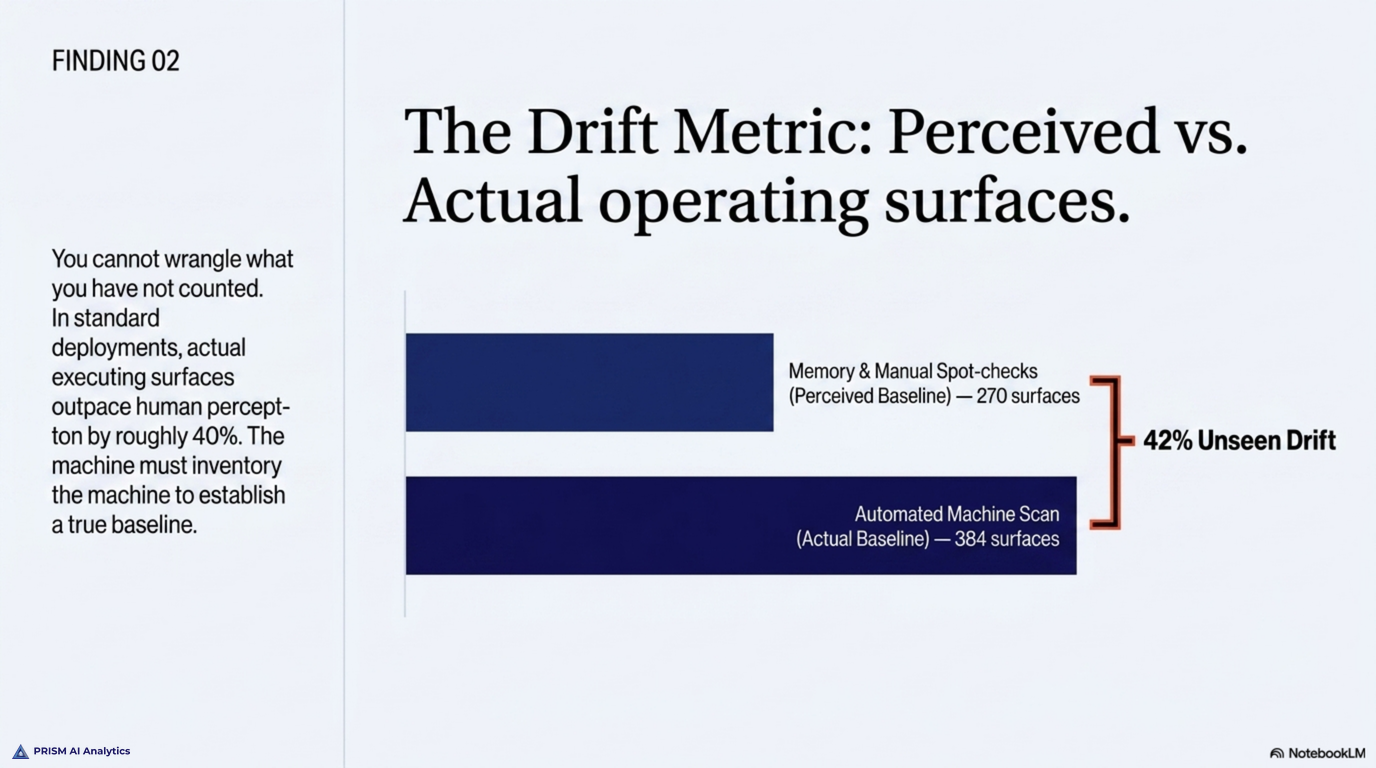
| Total | 384 |
An earlier count, a few weeks before, came in around 270. It grew by roughly forty percent while I was busy using it — not because I went on a building spree, but because that is what a working AI environment does. It accumulates. The most clarifying number in my own practice was not a benchmark or a model score. It was the distance between how many moving parts I thought I had and how many were actually there.
You cannot wrangle what you have not counted. And you cannot count it by hand, because the count is stale the moment you finish — which is exactly why I let the machine do the counting.
What staying in control actually requires
Strip the problem down and wrangling in the wild asks three things of you, in order. None of them is exotic. All of them are hard to do by hand.
The first is seeing — an honest, current inventory of every agent and every surface that shapes its behavior, not the version in your memory. This is the foundation, and it is the one almost everyone skips, because it produces no dashboard and demos badly.
The second is understanding what changed — knowing not just that a thing exists, but whether it is still the thing you approved. A name tells you something is there. It does not tell you that the connector you set up read-only in March is now doing something else, or that a hook you wrote to block an action was quietly edited to allow it. Control lives in the difference between two points in time, and you only see the difference if you wrote down the first one.
The third is being able to act — to notice deviation and step in before it becomes loss, rather than reading about it in the forensic logs afterward. This is the part wrangling is worst at, because the speed of an agent and the speed of a human noticing are not the same speed, and the distance between them is exactly where the trouble happens.
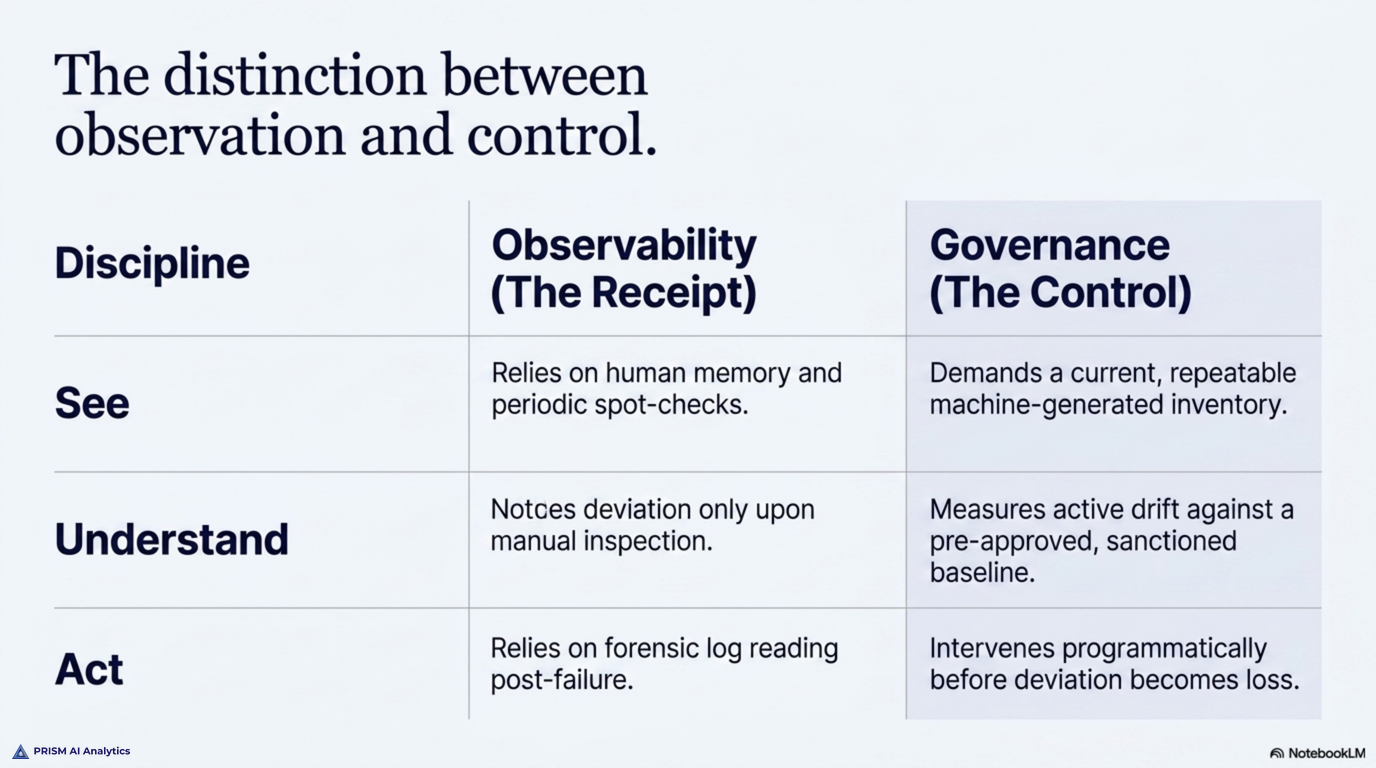
Put plainly, the gap between wrangling and control is the same three rows every time:
| What it takes | What wrangling does | What control needs |
|---|---|---|
| See | Relies on memory and spot-checks | A current, repeatable inventory |
| Understand what changed | Notices problems if you happen to look | Drift measured against an approved baseline |
| Act | Reads the logs after the fact | Intervenes before deviation becomes loss |
Trying to get your arms around the AI you already have running? Start a conversation about what you’re actually working with. The honest inventory alone changes the question.
What I learned building the control instead of improvising it
The thing that moved me from wrangling to something steadier was deciding to treat my own agents the way a disciplined operation treats anything consequential: write down the approved state, watch for drift from it, and make every agent leave a trail.
In practice that meant a few concrete things. A read-only scan that produces the inventory on demand, so the map stops going stale the day after I draw it. An approved baseline for each surface — what is supposed to exist, at what level of trust, signed off by whom — so a change is measurable against something instead of against a vague memory. And a working rule that no agent blocks silently or acts unilaterally on a real judgment call: when one of mine hits a decision that is genuinely mine to make, it stops and surfaces the question to a single screen I actually look at, and waits.
I want to be honest about the cost. This is more work than wrangling. It is attention spent on the system itself rather than on the output. But it bought me the one thing wrangling never could — the ability to answer what is running, is it still what I approved, and can I stop it without a sinking feeling. That is not a luxury once agents are doing real work. It is the floor.
Where wrangling finally breaks
Here is the part worth saying plainly, because it is the whole reason this matters. Wrangling does not fail gradually. It fails at a threshold. As long as you have a handful of agents and you are the only operator, watching by hand is survivable. Add a few more agents, or a second person making changes, or a workflow that runs while you sleep, and the manual approach does not get harder — it stops working. The quiet failures pile up in the gap you are no longer big enough to cover.
That threshold is closer than most people think, and it is the line between I have some AI agents and I am accountable for what a fleet of them does. Crossing it without a system is how capable, well-meaning teams end up surprised by their own software.
Where to start if this is sitting uncomfortably true
You do not need a framework this week. You need one honest inventory — and you should not produce it by hand.
Point your AI at your own environment and have it enumerate everything running: every agent, automation, hook, and connector — the ones that are actually there, not the ones you remember setting up. Memory is the thing that fails here; that is the whole lesson, and it is why I had Claude produce mine rather than reconstruct it myself. Then take the list it gives you and ask two questions of each item: do I know what this is allowed to do, and would I notice if that changed? The items where the answer is no are not failures. They are your map of where the wild is.
That afternoon is the on-ramp to everything else — the first layer of a real governance practice, the one I call Discover and Map, and the rest of the disciplines that sit on top of it. But the framework is not the point of this post. The point is the recognition. If you have agents in the wild and no honest count of them, you are wrangling, and wrangling has a ceiling. Better to find the ceiling on purpose than to hit it by accident.
*Prism AI Analytics helps solopreneurs and small teams get their arms around the AI they are already running — and build the discipline to govern it as it grows. If this is sitting uncomfortably true, start a conversation.*
Ready to See What You’re Actually Running?
Prism AI Analytics helps small teams move from wrangling AI agents by hand to governing them by design. We start where it counts — an honest inventory of every agent, automation, and connector you have running — and build the control plane that keeps it from going stale.