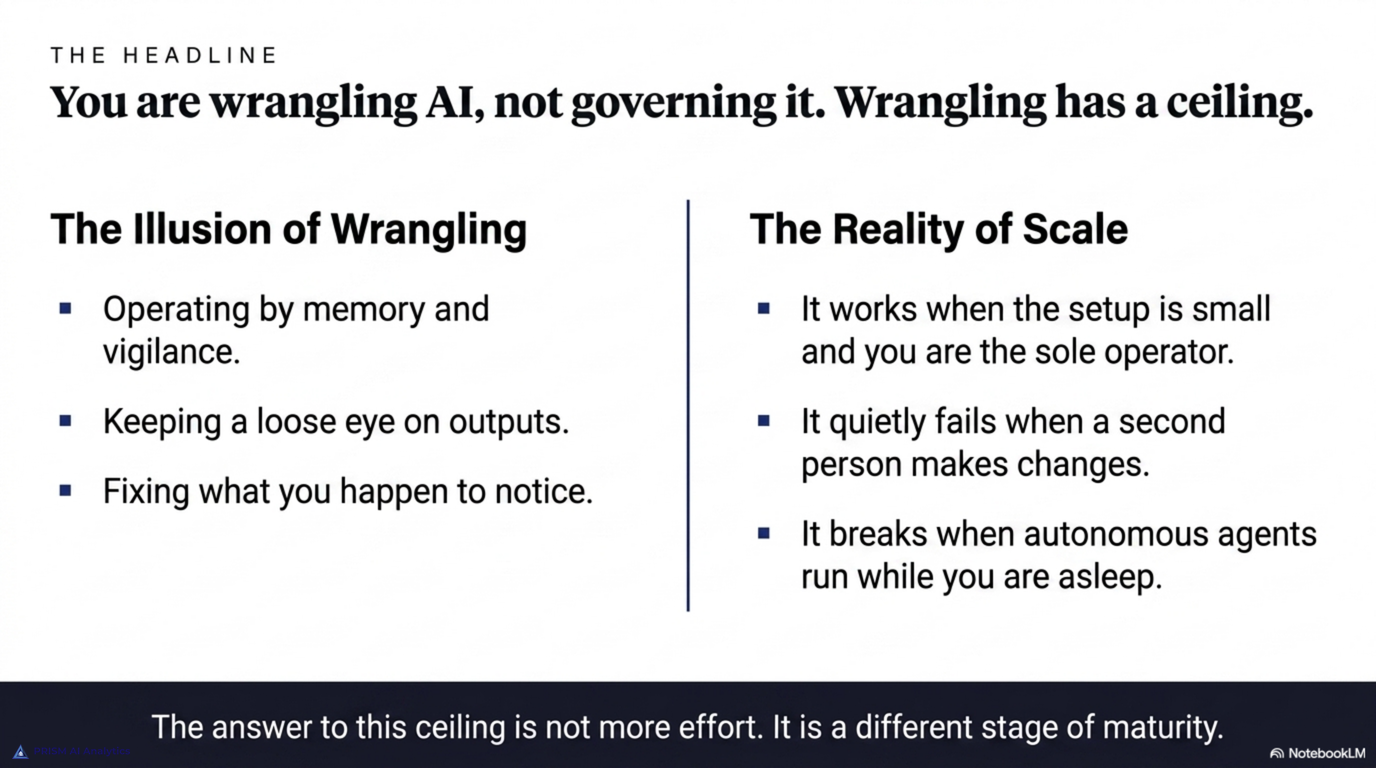
In a recent post I argued that most teams running AI agents are wrangling them — keeping a loose eye on the output, remembering roughly what is set up, fixing what they happen to notice — and that wrangling has a ceiling it hits sooner than anyone expects. This post is about what is on the other side of that ceiling, because "stop wrangling" is not useful advice unless you can say what to do instead.
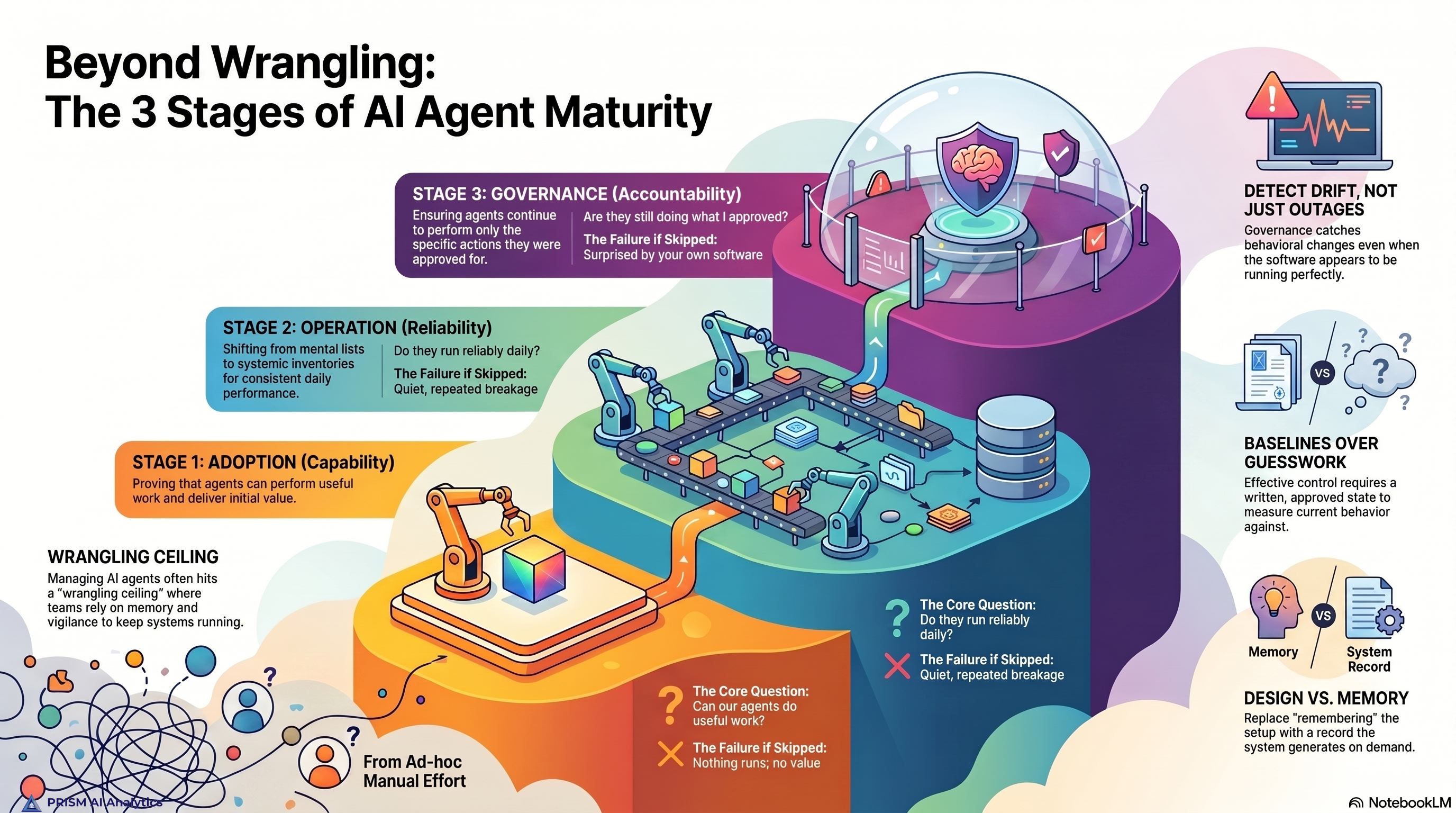
The answer is not more effort. It is a different stage of maturity. Living with AI agents has three of them, and almost everyone stops talking after the first.
Adoption is the first stage, not the finish line
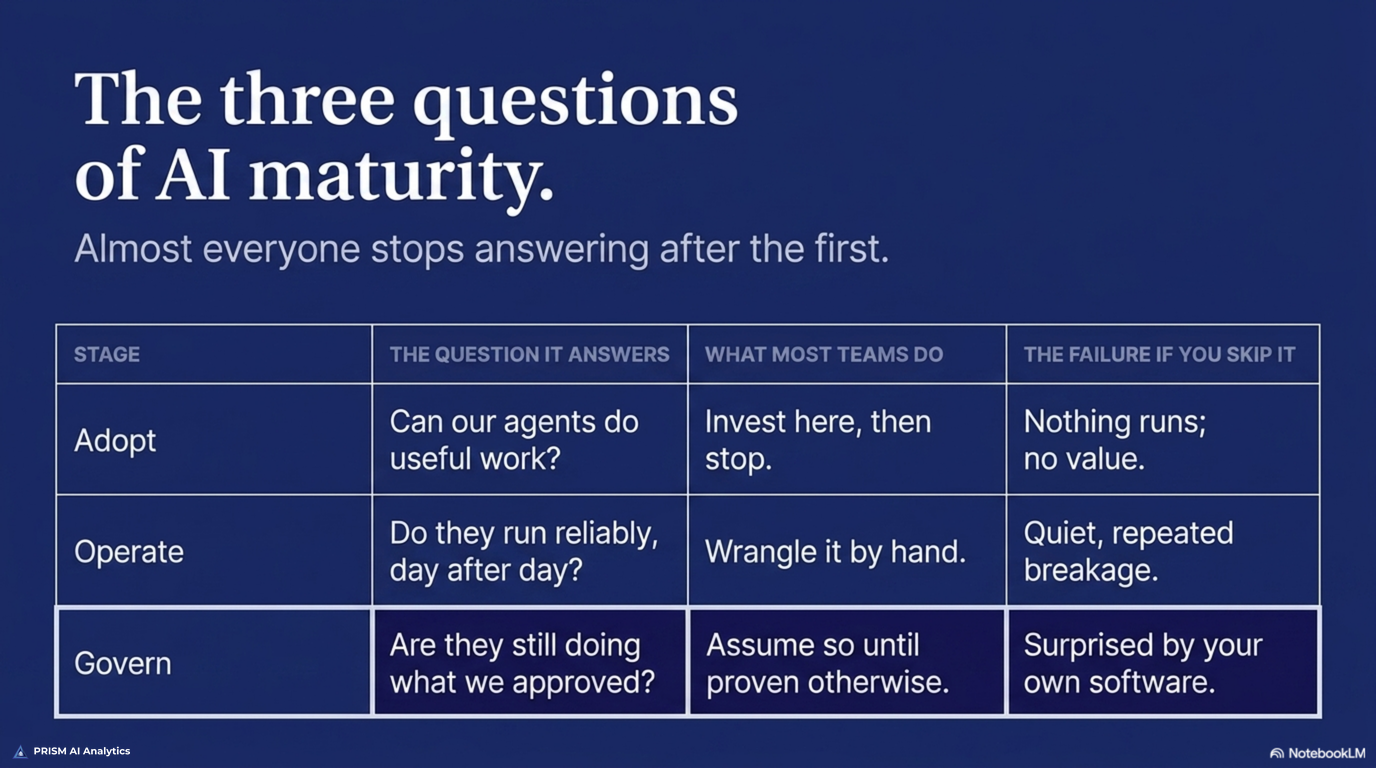
The dominant story about AI right now ends at adoption. A team gets agents doing useful work, declares the project a success, and moves on. That instinct is understandable and it is also where the trouble starts, because adoption answers only the easiest of three questions.
| Stage | The question it answers | What most teams do | The failure if you skip it |
|---|---|---|---|
| Adopt | Can our agents do useful work? | Invest here, then stop | Nothing runs; no value |
| Operate | Do they run reliably, day after day? | Wrangle it by hand | Quiet, repeated breakage |
| Govern | Are they still doing what we approved? | Assume so until proven otherwise | Surprised by your own software |
Adoption is real work and worth celebrating. But an agent that does useful work on Tuesday is not the same as a fleet you can account for in October. The gap between those two things is the two stages nobody put on the roadmap.
Operate: the stage everyone is improvising
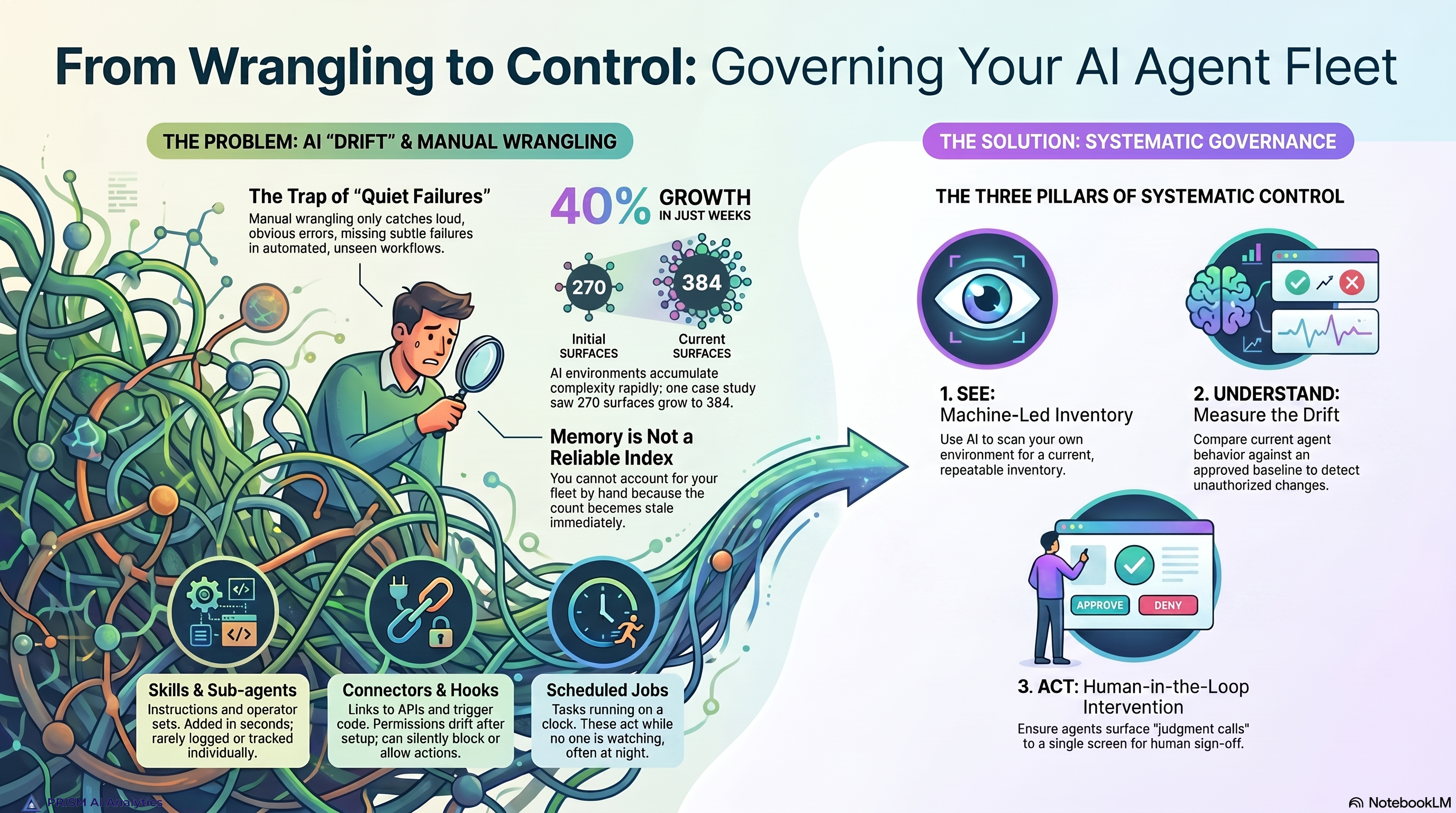
Operating is the day-to-day of keeping agents running well — and it is exactly the stage where wrangling lives. Most teams operate by memory and vigilance. It works while the setup is small and you are the only one touching it. It quietly stops working when a second person makes changes, or a few more agents appear, or a job starts running while you are asleep.
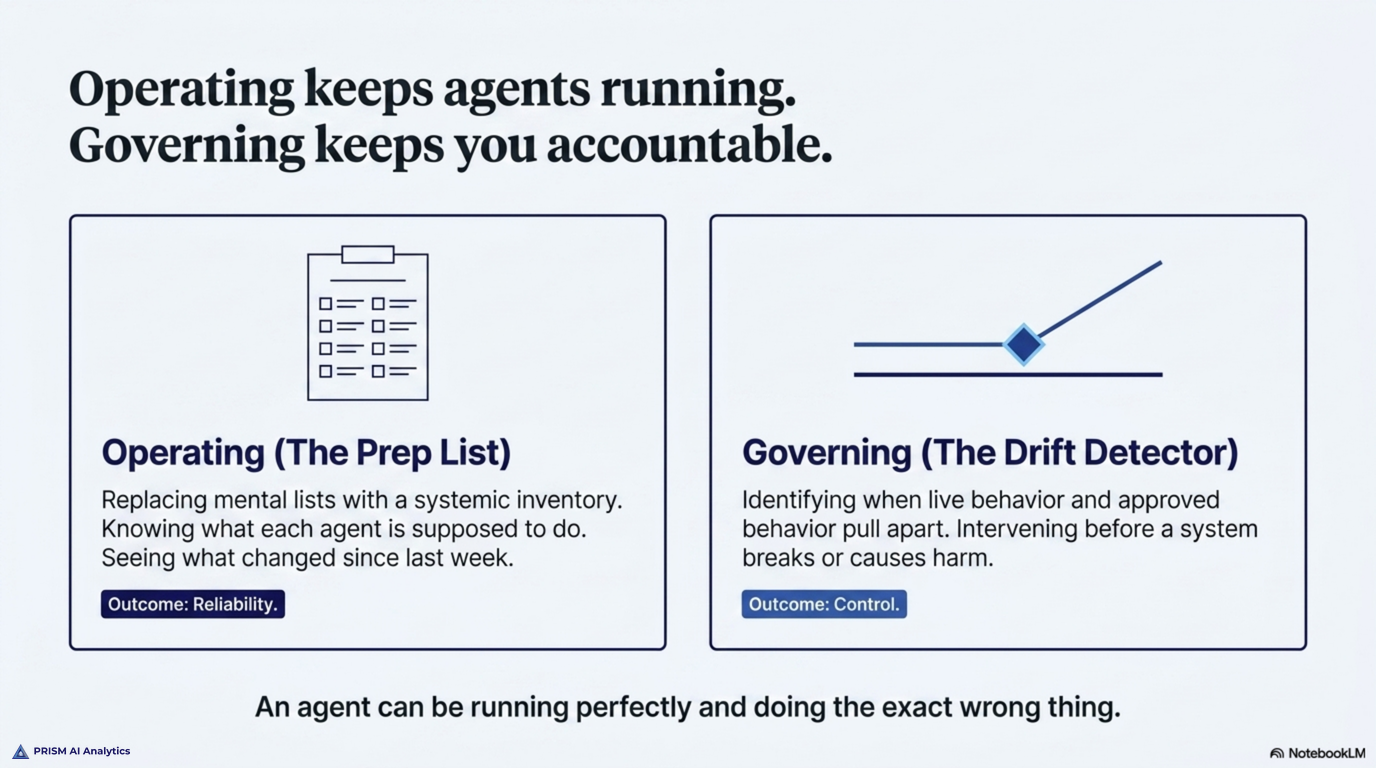
The shift from wrangling to operating well is not about watching harder. It is about replacing the things you were doing in your head with things the system does on purpose:
- A current inventory you can regenerate on demand, instead of a mental list that is always a little out of date.
- A record of what each agent is supposed to do, written down once, instead of re-derived every time someone asks.
- A way to see what changed since last week, instead of discovering it when something breaks.
None of that is exotic. It is the difference between a kitchen run from memory and a kitchen run from a prep list. The food is not better because someone wrote the list. The kitchen stops falling apart the night the regular cook is out.
Govern: the stage that keeps you accountable
Governing is the stage almost no one reaches, and it is the one that matters most once agents touch anything real. Operating asks are my agents running? Governing asks a harder question: are they still doing what I approved — and would I know if they weren’t?
That distinction is the whole game. An agent can be running perfectly and doing the wrong thing. A connector you set up read-only in spring can be doing more by summer. A rule you wrote to block an action can be quietly changed to allow it. Operating notices when something stops. Governing notices when something drifts — when the live behavior and the approved behavior pull apart while everything still appears to work.
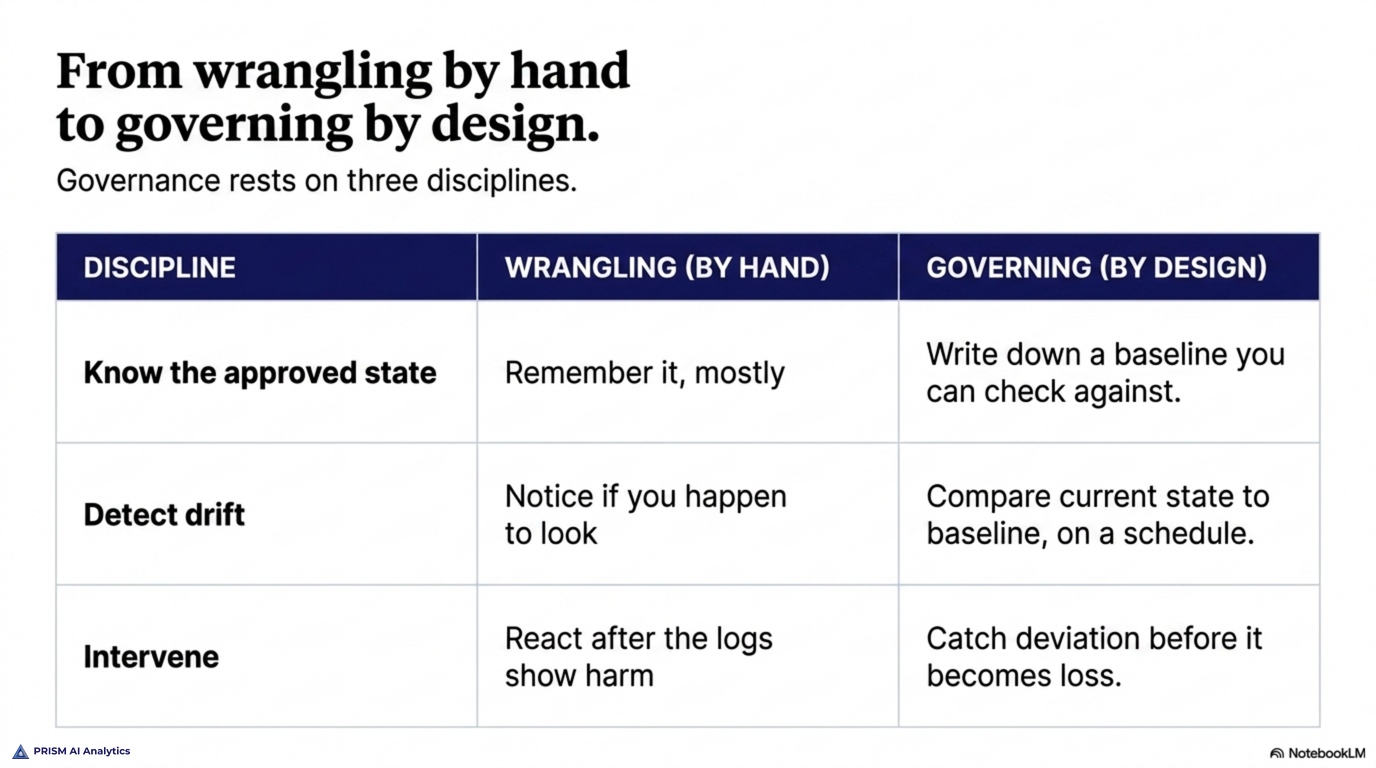
Governing rests on three disciplines, and the move from wrangling to governing is the move from doing each by hand to doing each by design:
| Discipline | Wrangling (by hand) | Governing (by design) |
|---|---|---|
| Know the approved state | Remember it, mostly | Write down a baseline you can check against |
| Detect drift | Notice if you happen to look | Compare current state to baseline, on a schedule |
| Intervene | React after the logs show harm | Catch deviation before it becomes loss |
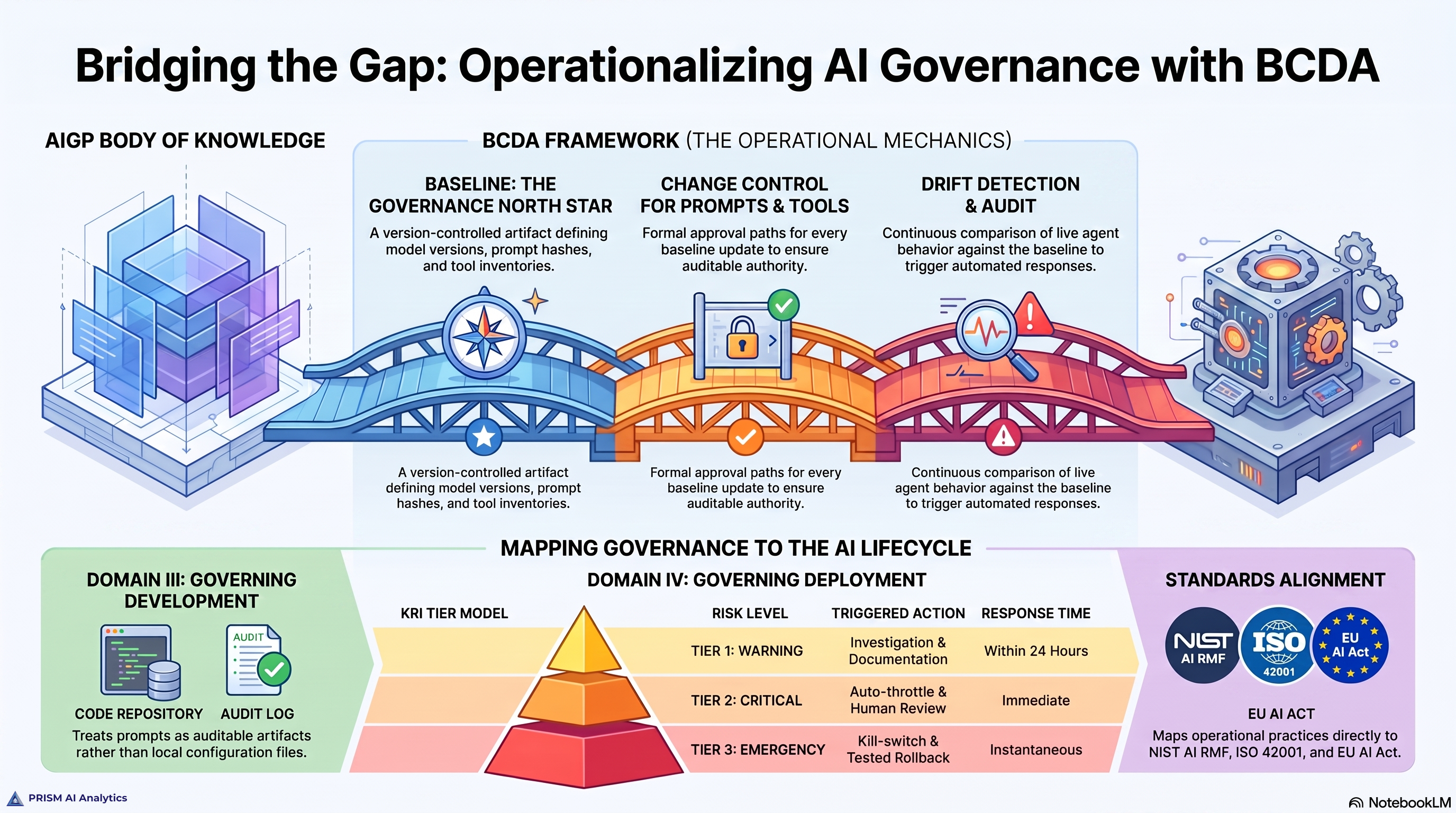
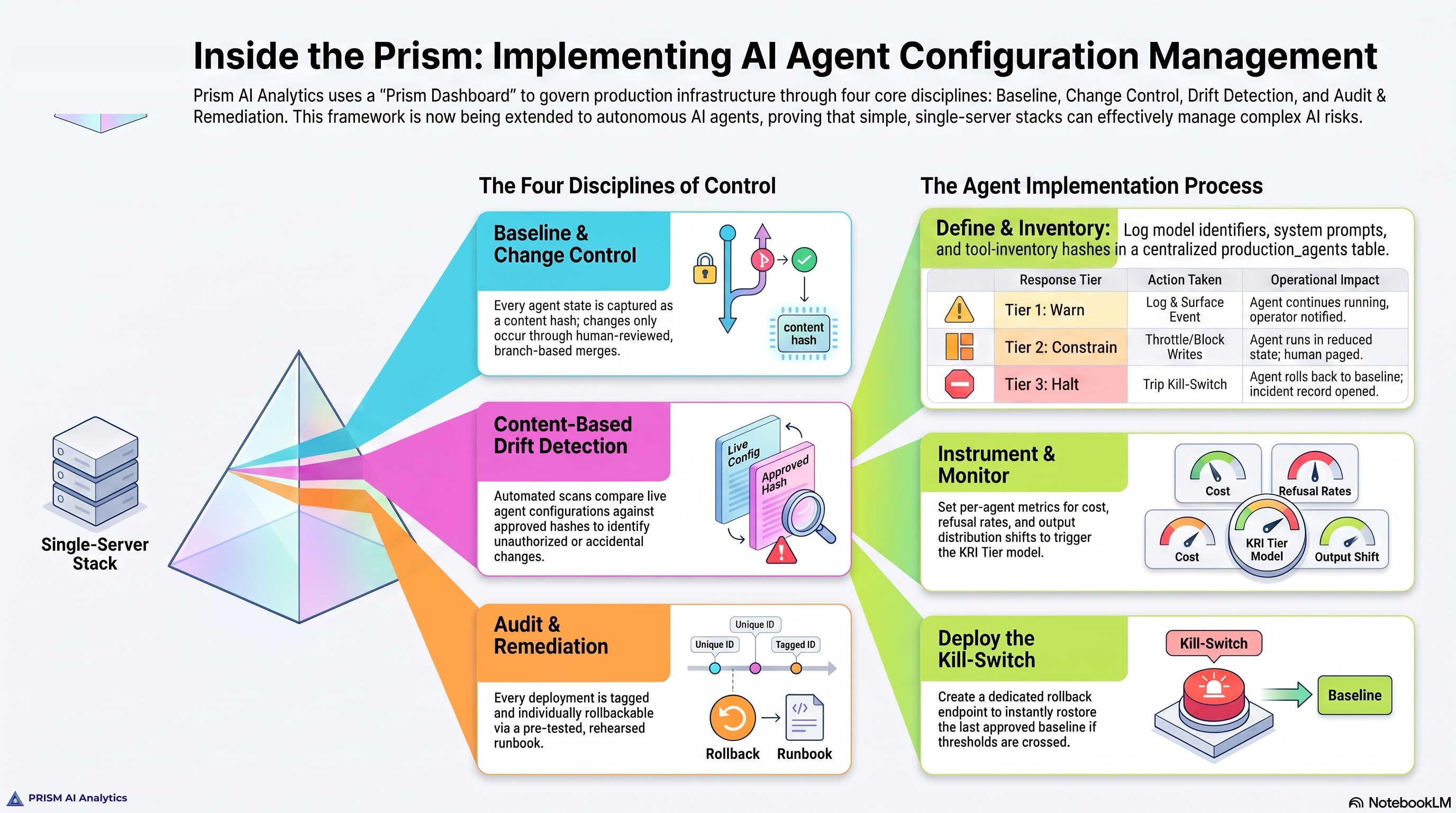
This is the layer I spend most of my time on, and it is the layer the rest of the Prism CM-AI framework is built to make practical. But the framework is downstream of the recognition. The recognition is that governance is a stage you graduate to, not a document you write once and file.
Why the stages are a ladder, not a menu
You cannot govern what you do not operate, and you cannot operate what you have not adopted. The stages stack. Skipping one does not save time; it relocates the cost to a worse moment.
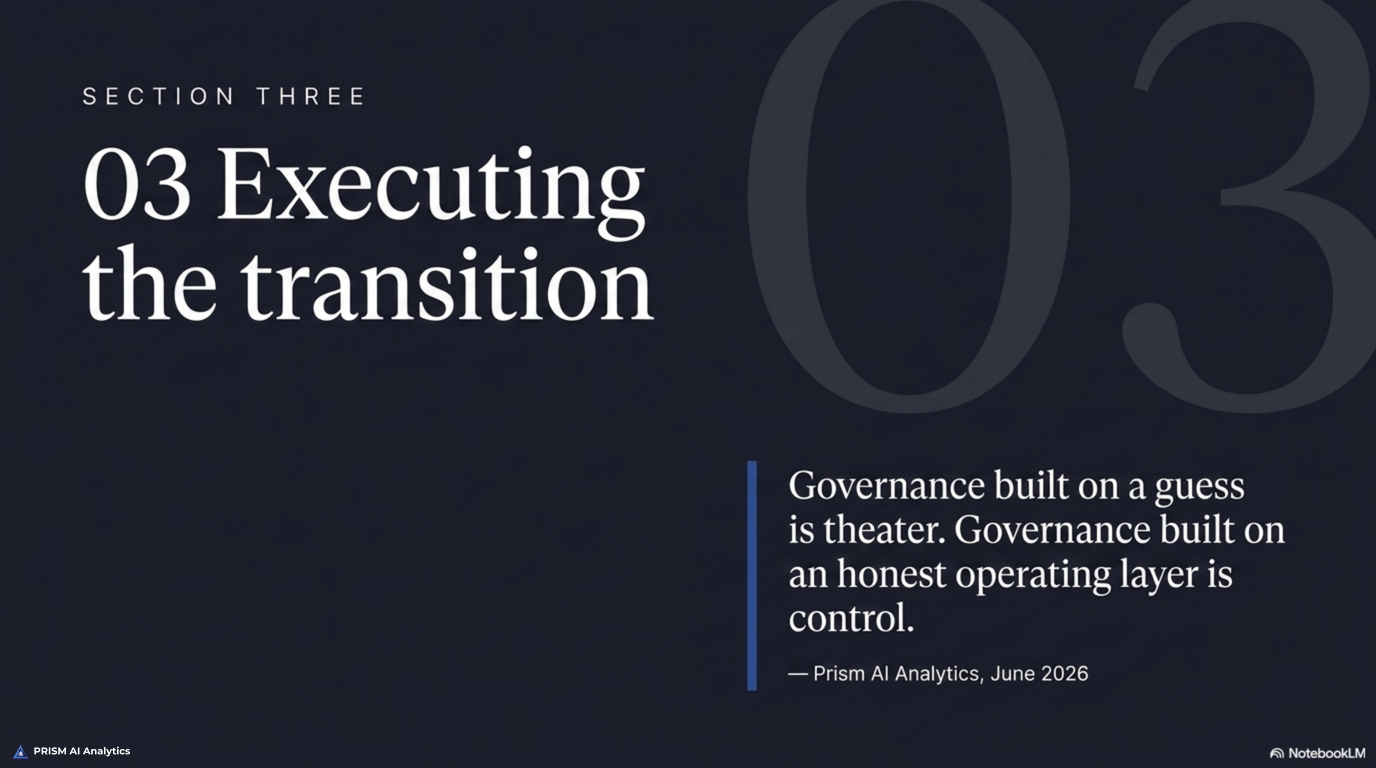
The common mistake is trying to bolt governance on at the end — buying a policy, a dashboard, an ethics statement — on top of an operation that is still being run from memory. It does not hold, because governance needs an approved baseline to measure against, and you only have a baseline if you did the operating work of writing down what good looks like. Governance built on a guess is theater. Governance built on an honest operating layer is control.
The encouraging part is that the ladder is climbable at any size. You do not need a hundred agents or a compliance department. You need to know which stage you are actually on, and to take the next rung deliberately rather than assume adoption was the whole climb.
Where to start if you have adopted and stalled
If you have agents doing useful work and a growing unease about keeping track of them, you are at the top of stage one looking up. The next rung is not a purchase. It is three honest moves:
- Make operating real. Generate an actual inventory of everything running — not from memory — and write down, once, what each agent is supposed to do.
- Pick your baseline. Decide what the approved state is, so that "it changed" becomes a thing you can detect instead of a thing you stumble into.
- Build the smallest intervention you trust. Even a single rule that makes an agent stop and ask before a consequential action is the start of governing.
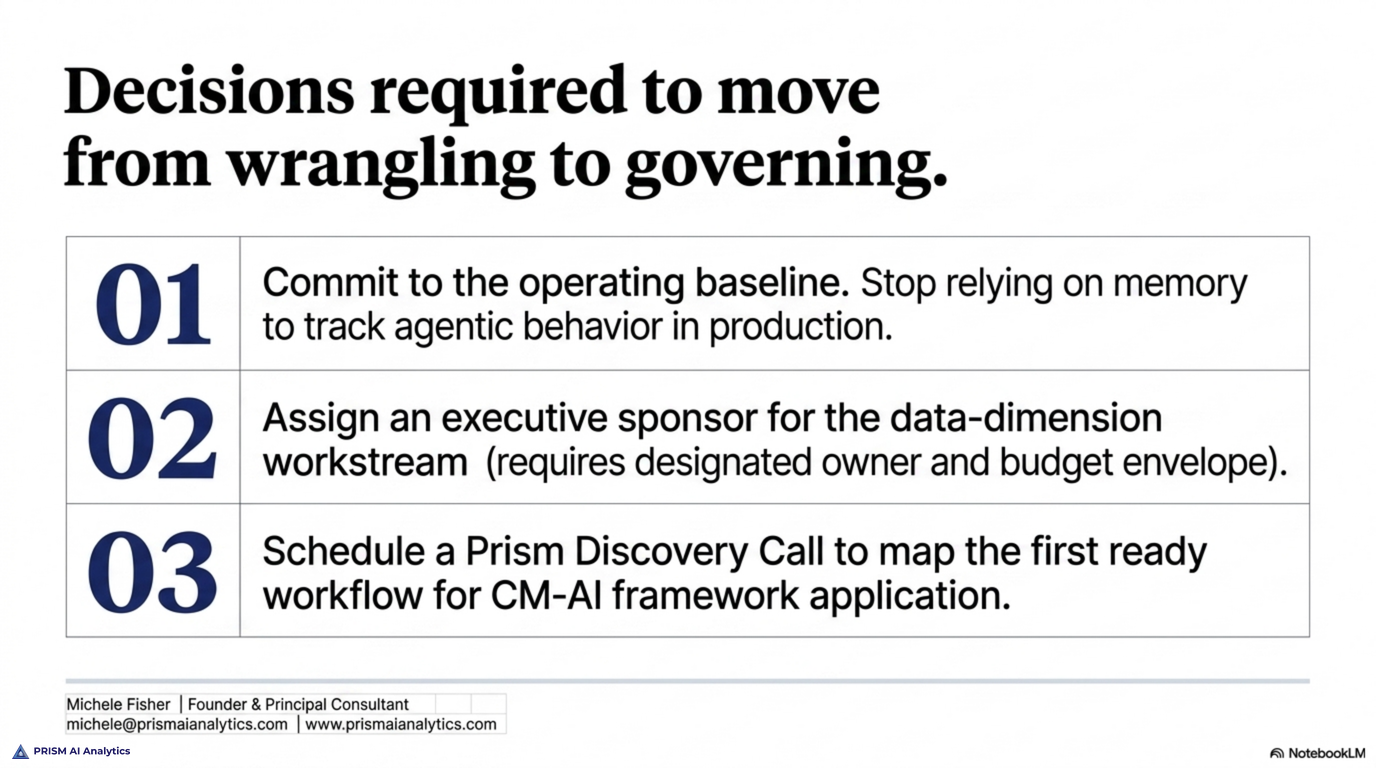
That third move is the one that changes how it feels to run AI agents. Adoption gives you capability. Operating gives you reliability. Governing gives you the one thing wrangling never could — the ability to say, at any moment, this is what is running, this is what it is allowed to do, and I would know if that changed. That is not bureaucracy. At the speed agents act, it is the difference between being in charge of your software and being informed by it after the fact.
*Prism AI Analytics helps small teams climb from adoption to real operating and governing discipline — without enterprise overhead. If you have adopted AI and stalled at "we think it’s fine," start a conversation.*
Ready to Move From Wrangling to Governing?
Prism AI Analytics helps solopreneurs and small teams turn ad hoc AI use into a governed operation — inventory, approved baselines, drift detection, and the ability to intervene before something goes wrong. We meet you on the rung you are actually standing on.