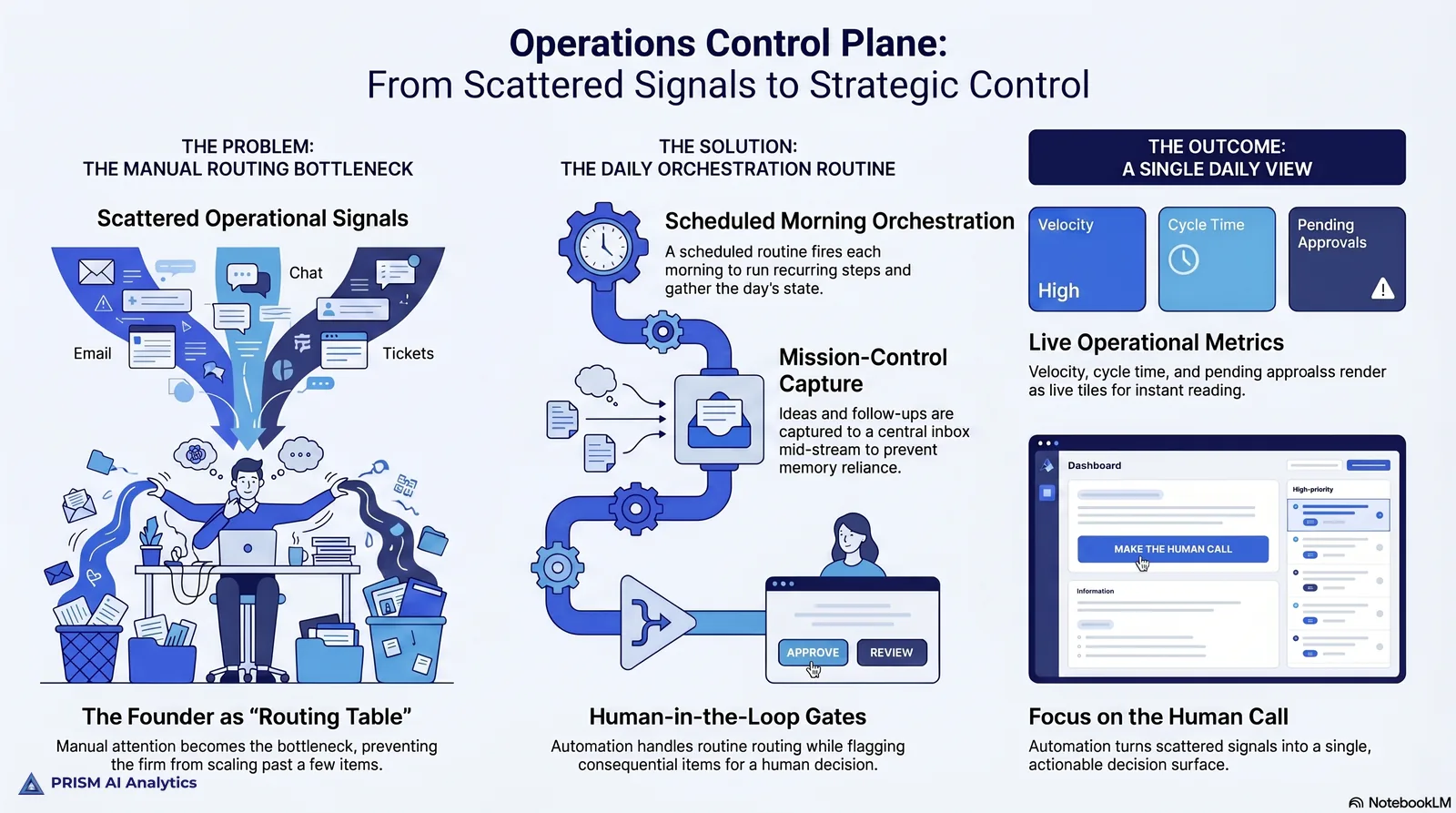
Before (the problem)
Operational signals arrive scattered: a decision owed here, a captured idea there,
a routine that should have run, a ticket waiting on a human call. Without one place
that gathers them, the founder’s attention is the routing table — and that does not
scale past a few items a day.
What we built
A daily operations control plane:
- A daily orchestration routine that runs the firm’s recurring work
- A mission-control inbox for capturing ideas the moment they surface
- Decision tracking that separates “needs a human call” from “route the rest”
- Human-in-the-loop gates on anything consequential
How it works
- A scheduled orchestrator routine fires each morning and runs the day’s recurring
steps.
- Ideas and follow-ups are captured to the inbox mid-stream, not lost.
- Items needing a decision are flagged and surfaced; everything else is routed.
- A daily view shows what is in flight and what is waiting on a decision.
Outcomes
- Scattered operational signals → one daily view of in-flight vs awaiting-decision
- Captures decisions and ideas instead of relying on memory
- Human gates keep automation from acting unsupervised on consequential steps
Stack & role
Node.js · Scheduled automation · Human-in-the-loop gates. Built & operated in-house.
Timeline
Built in-house; live, running daily.
What it proves
Operations for a lean firm is a routing problem. This turns scattered signals into a
single daily decision surface — automation handles the routing, a human keeps the
call.