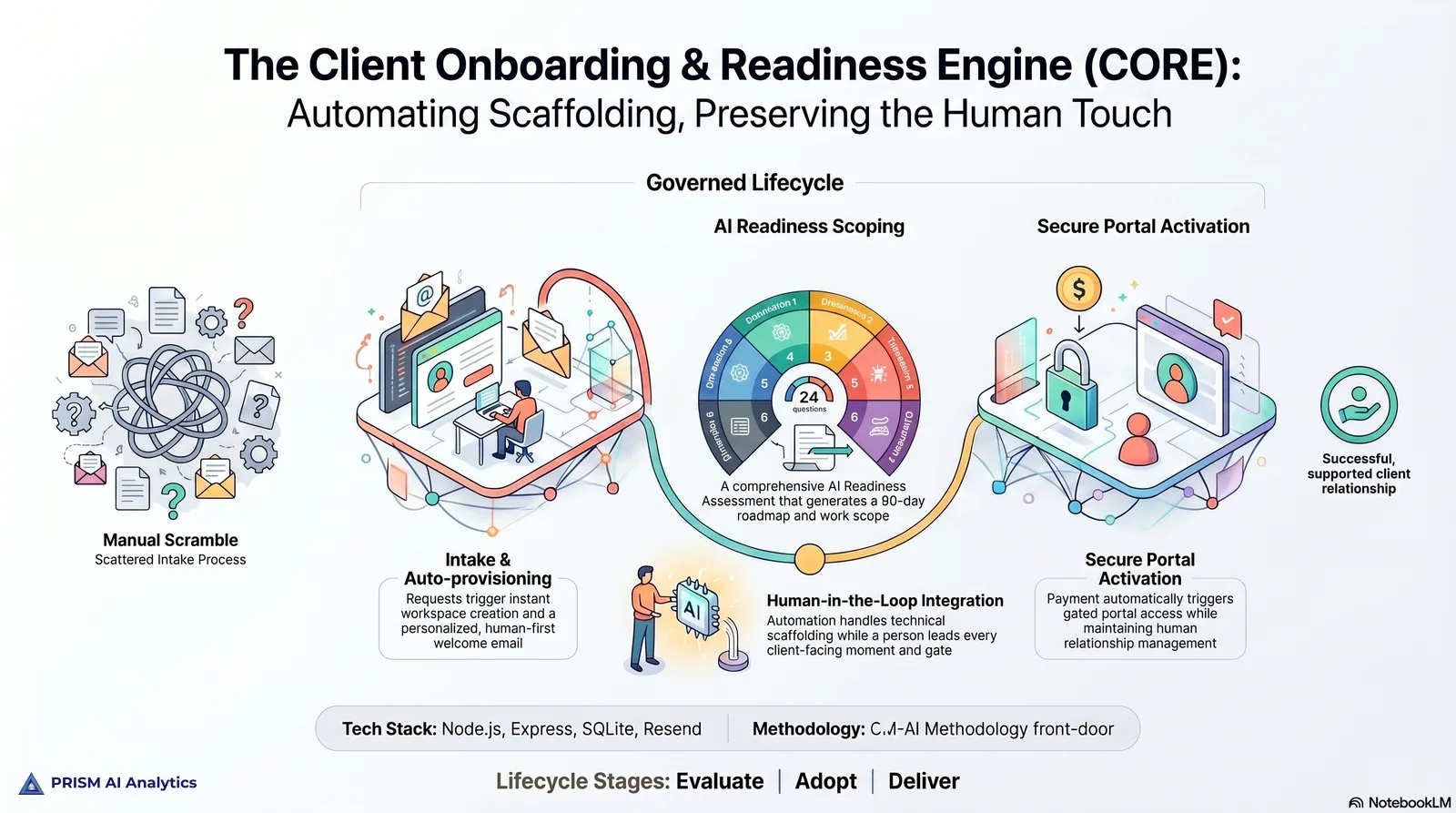
Before (the problem)
Client intake for most small firms is a scattered, manual scramble: a new request
arrives, and provisioning a workspace, sending a welcome, scoping the work, and
opening access all happen by hand, inconsistently, with the client’s first
impression left to chance.
What we built
An end-to-end onboarding pipeline that keeps a person at every client touchpoint:
- Auto-provisioning — a new request creates a client workspace and a warm,
human-first welcome
- AI Readiness Assessment — a six-dimension, 24-question diagnostic that scopes
the work
- Gated client portal — any payment opens portal access
- Human-in-the-loop — a person leads every client-facing moment
How it works
- A new request auto-provisions a client workspace.
- A warm, human-first welcome goes out (transactional email via Resend).
- The six-dimension AI Readiness Assessment scopes the engagement.
- The assessment yields a band placement plus a debrief and 90-day roadmap.
- Payment opens a gated client portal — automation handles scaffolding, a person
handles the relationship.
Outcomes
- A scattered manual intake → one governed lifecycle: evaluate → adopt → deliver
- 6 dimensions, 24 questions in the readiness diagnostic
- 3-stage lifecycle with a human gate at every client-facing step
- Automation never replaces a person at the client’s door
Stack & role
Node.js · Express · SQLite · Resend · Human-in-the-loop gates. Built & operated
in-house.
Timeline
Built in-house; live. The AI Readiness Assessment is the operational front door for
the CM-AI methodology.
What it proves
Onboarding can be governed without being cold. This turns intake into a repeatable
lifecycle where automation does the scaffolding and a person is never replaced where
it matters.